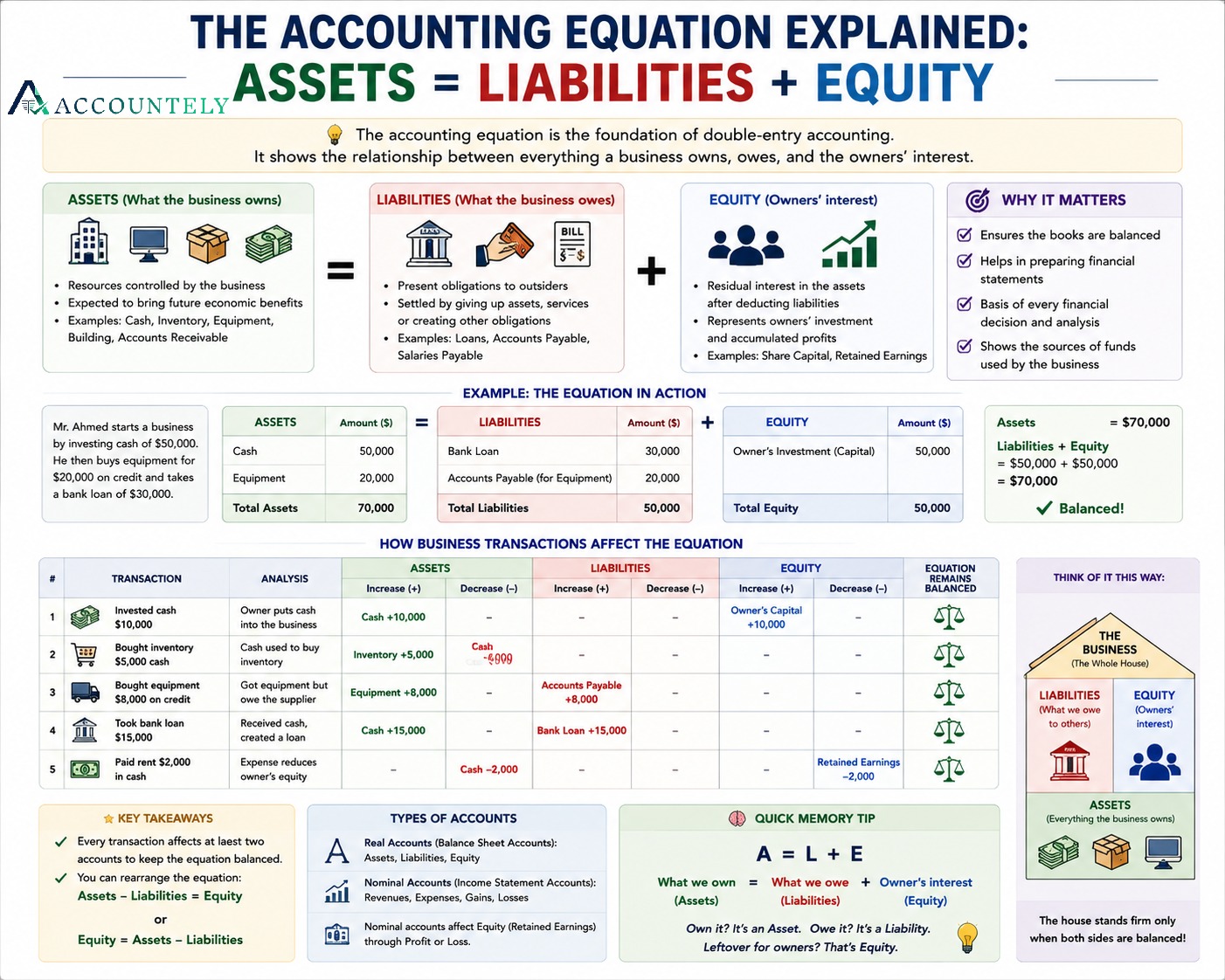
Assets = Liabilities + Equity. Three terms, one equals sign — and yet almost the entire discipline of accounting is built on making sure this equation never breaks. Here's what it actually means and why it's impossible to violate if the bookkeeping is done correctly.
What Each Term Means
- Assets — everything the business owns or controls that has future economic value: cash, inventory, equipment, receivables.
- Liabilities — everything the business owes to outsiders: loans, accounts payable, accrued expenses.
- Equity — what's left for the owners after liabilities are subtracted from assets. It's a residual claim, not a separate pool of resources.
Rearranged, the equation reads: Equity = Assets − Liabilities. That's literally what equity is — whatever value remains once every outside claim on the business's assets has been paid off.
Why It Always Balances
The accounting equation holds because of double-entry bookkeeping: every transaction is recorded with equal debits and credits, and every debit/credit pair is chosen specifically so the equation stays true. It's not that the equation happens to balance — the rules of debits and credits are designed around keeping it balanced at all times, transaction by transaction, not just at the end of the year.
Watching the Equation Move
Every transaction affects the equation in one of a few predictable ways:
- Asset for asset: buying equipment with cash — one asset up, another down, equation untouched.
- Asset and liability together: buying equipment on credit — assets up, liabilities up, equally.
- Asset and equity together: the owner invests cash — assets up, equity up, equally.
- Equity moves through profit: earning revenue increases assets (cash or receivables) and increases equity, via net income; incurring an expense decreases assets (or increases a liability) and decreases equity.
A Worked Example
Start with a business that has $10,000 cash, no liabilities, and $10,000 equity — the equation balances trivially. Now three things happen:
- The business borrows $5,000 from a bank. Assets (cash) rise to $15,000; liabilities rise to $5,000; equity stays at $10,000. Check: 15,000 = 5,000 + 10,000. ✓
- It buys equipment for $8,000 cash. Cash falls to $7,000, equipment rises to $8,000 — assets are still $15,000 total, nothing else changes. ✓
- It earns $2,000 in cash revenue. Cash rises to $9,000 (assets now $17,000); equity rises to $12,000 via net income. Check: 17,000 = 5,000 + 12,000. ✓
Why This Matters Beyond the Exam
The accounting equation is the reason a trial balance and balance sheet are expected to balance at all. When they don't, it's not the equation that's wrong — it's a bookkeeping error somewhere upstream: an entry with unequal debits and credits, a transaction posted to the wrong account, or a figure transcribed incorrectly.
The best way to internalise how transactions move the equation is to work through them yourself. Accountely's journal entry challenges and balance sheet challenges give instant, line-by-line feedback so you can see the equation hold — or catch exactly where it broke.