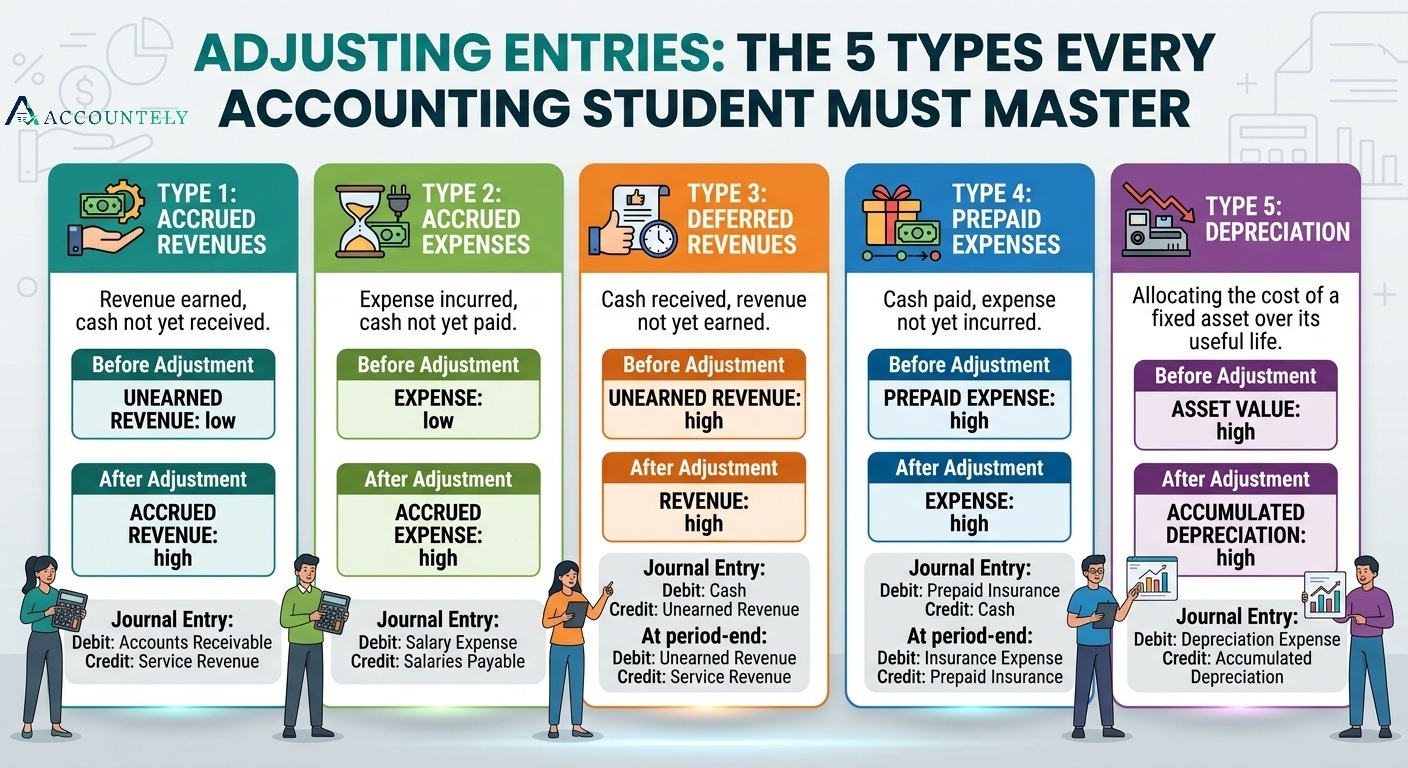
Adjusting entries are the reason a company's books actually reflect reality at period-end, rather than just whatever happened to involve cash. They're also one of the most heavily tested topics in intro accounting, because they force you to apply the accrual concept rather than just recognise a transaction on sight. Here are the five types you'll see over and over, each with a worked example.
Why Adjusting Entries Exist
Under accrual accounting, revenue is recognised when earned and expenses are recognised when incurred — regardless of when cash actually moves. Day-to-day bookkeeping captures most of that automatically, but a handful of situations only become clear at the end of a period: time has passed, but no invoice or receipt triggered an entry. Adjusting entries close that gap before the financial statements are prepared.
The 5 Types of Adjusting Entries
1. Accrued Revenue
Revenue that's been earned but not yet billed or collected. Example: a consulting firm has worked 10 hours at $100/hour by month-end but won't invoice until next month.
Dr Accounts Receivable $1,000 — Cr Service Revenue $1,000
2. Accrued Expense
A cost that's been incurred but not yet paid or billed. Example: employees have earned $4,000 in wages by month-end, to be paid next payday.
Dr Wages Expense $4,000 — Cr Wages Payable $4,000
3. Deferred (Unearned) Revenue
Cash was received in advance, before the service was actually performed. As the service is delivered, the liability is worked off into revenue. Example: a customer paid $6,000 upfront for a 6-month service contract; one month has now passed.
Dr Unearned Revenue $1,000 — Cr Service Revenue $1,000
4. Deferred (Prepaid) Expense
Cash was paid in advance for something that will be used up over time. Example: a 12-month insurance policy was paid for at $2,400; one month has now passed.
Dr Insurance Expense $200 — Cr Prepaid Insurance $200
5. Depreciation
The systematic allocation of an asset's cost over its useful life. Example: equipment depreciates at $500 per month under the straight-line method.
Dr Depreciation Expense $500 — Cr Accumulated Depreciation $500
How Adjusting Entries Differ From Regular Journal Entries
Every adjusting entry has one thing in common: it never involves the Cash account. Cash already moved (or never will, in the case of accruals) — the adjustment is purely about recognising revenue or expense in the correct period. If an entry you're writing at period-end touches Cash, it isn't an adjusting entry.
A Combined Worked Example
At month-end, a company reviews its accounts and identifies: $800 of interest earned on a note receivable but not yet received; $300 of unpaid utilities for the month; a $1,200 twelve-month prepaid rent policy with one month elapsed ($100); and equipment depreciating $250 for the month. Four separate adjusting entries are needed:
Dr Interest Receivable $800 — Cr Interest Revenue $800
Dr Utilities Expense $300 — Cr Utilities Payable $300
Dr Rent Expense $100 — Cr Prepaid Rent $100
Dr Depreciation Expense $250 — Cr Accumulated Depreciation $250
How to tell which type you are looking at
In an exam the five types blur together, because the question rarely names them. Two questions separate them reliably.
First: has the cash already moved? If cash changed hands earlier, you are dealing with a deferral — something was recorded as an asset or a liability and part of it now needs releasing. If no cash has moved at all, you are dealing with an accrual, and you are recognising something before any payment.
Second: is this revenue or expense? That decides the direction.
| Cash moved? | Revenue or expense? | Type | Entry shape |
|---|---|---|---|
| Not yet | Revenue | Accrued revenue | Dr Receivable / Cr Revenue |
| Not yet | Expense | Accrued expense | Dr Expense / Cr Payable |
| Already, from customer | Revenue | Deferred revenue | Dr Unearned Revenue / Cr Revenue |
| Already, to supplier | Expense | Prepaid expense | Dr Expense / Cr Prepaid |
| Long ago, on an asset | Expense | Depreciation | Dr Expense / Cr Accumulated Depreciation |
Every adjusting entry crosses the statements: one income statement account, one balance sheet account. If you have written one that touches two balance sheet accounts, or two income statement accounts, it is not an adjusting entry and something has gone wrong.
What happens if you miss one
Adjusting entries are worth taking seriously because an omission never stays contained — it distorts both statements at once, in a predictable direction. Being able to state that direction is a common exam requirement in its own right.
| Omitted adjustment | Effect on profit | Effect on balance sheet |
|---|---|---|
| Accrued revenue | Understated | Assets understated |
| Accrued expense | Overstated | Liabilities understated |
| Deferred revenue earned | Understated | Liabilities overstated |
| Prepaid expense used | Overstated | Assets overstated |
| Depreciation | Overstated | Assets overstated |
There is a pattern under the table. Miss an expense adjustment and you overstate profit; miss a revenue adjustment and you understate it. Because profit closes into equity, every one of these also leaves the balance sheet wrong by the same amount — which is precisely why it still balances. A balanced balance sheet is not evidence the adjustments were made.
Reversing entries
Some accruals are reversed on the first day of the next period, deliberately undoing the adjustment before the real transaction arrives. It looks redundant and it is optional, but it exists to stop double counting.
Suppose you accrue $4,000 of salaries at year end: debit Salaries Expense, credit Salaries Payable. In January the payroll of $10,000 is paid. Without a reversal, the bookkeeper has to remember that $4,000 of that payment belongs to last year and split the entry between Salaries Payable and Salaries Expense. With a reversal posted on 1 January, the payable is cleared and the whole $10,000 can be debited to Salaries Expense as normal — the $4,000 credit from the reversal cancels the overlap automatically.
The purpose is operational rather than theoretical: it lets routine transactions be recorded routinely, without anyone having to remember the prior period. Reversals apply to accruals; deferrals and depreciation are never reversed.
When the adjustment is an estimate
Depreciation is not the only adjustment resting on judgement. Allowances for doubtful debts, warranty provisions and accrued utilities where no bill has arrived all require an estimate, and estimates are revised as better information appears.
The important consequence is that revisions are applied prospectively. If the useful life of an asset is reassessed, you do not go back and restate previous depreciation — you spread the remaining carrying amount over the remaining life from now on. Treating a revised estimate as though it were an error, and restating comparatives for it, is one of the most frequently penalised mistakes in this area.
Common Mistakes
- Confusing accrued and deferred. Accrued means recognising something before cash moves; deferred means cash already moved and recognition is catching up.
- Adjusting for the full amount instead of the portion used. A 12-month prepaid expense adjusts by 1/12th per month, not the full amount at once.
- Skipping adjusting entries because "nothing happened." That's exactly the situation adjusting entries are for — no new transaction occurred, but time passed.
Adjusting entries feed directly into the trial balance and every statement built from it, so getting them right matters more than almost any other single skill in the intro course. Practice them with instant, line-by-line feedback on Accountely's journal entry challenges, then see how they flow into a full trial balance.