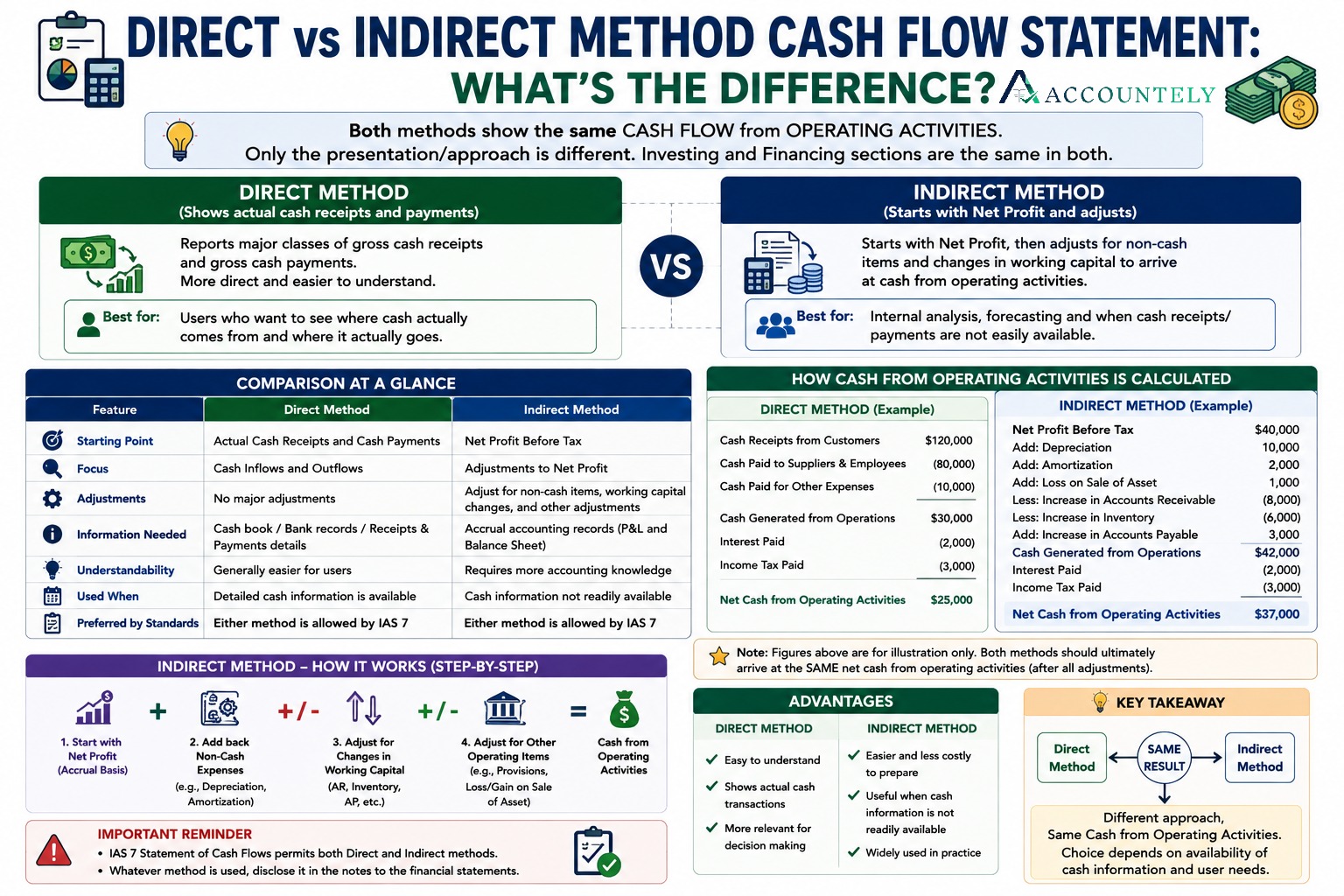
The cash flow statement is the one financial statement built entirely around a single question: where did the cash actually come from and go? IAS 7 permits two different ways to present the operating activities section — direct and indirect — and understanding the difference (and why almost every real company picks one of them) trips up a lot of students.
What Doesn't Change: The Other Two Sections
Investing and financing activities are presented identically under both methods — cash paid for equipment, cash received from issuing shares, cash used to repay a loan. The direct/indirect distinction only affects how the operating activities section is presented.
The Direct Method
The direct method lists actual cash inflows and outflows from operations — cash received from customers, cash paid to suppliers, cash paid for wages, cash paid for other operating expenses. It reads like a simplified, cash-only income statement.
Example (direct method, operating section):
Cash received from customers: $180,000
Cash paid to suppliers: ($95,000)
Cash paid for wages: ($40,000)
Cash paid for other operating expenses: ($12,000)
Net cash from operating activities: $33,000
The Indirect Method
The indirect method starts from net income (an accrual-based figure) and reconciles it back to cash by reversing out non-cash items and adjusting for changes in working capital.
Example (indirect method, operating section):
Net income: $28,000
Add: Depreciation expense: $10,000
Less: Increase in accounts receivable: ($6,000)
Add: Decrease in inventory: $4,000
Add: Increase in accounts payable: $3,000
Less: Decrease in accrued expenses: ($6,000)
Net cash from operating activities: $33,000
Notice both methods arrive at exactly the same operating cash flow figure — $33,000. They're two different roads to the same number.
Why Depreciation Gets "Added Back" (A Common Point of Confusion)
Depreciation is not a source of cash. It's added back under the indirect method purely because it was already subtracted in arriving at net income, but it never involved an actual cash outflow — so reconciling net income back to cash means reversing it out.
Why Most Companies Use the Indirect Method
IAS 7 explicitly encourages the direct method as it provides more useful information, but in practice the overwhelming majority of companies use the indirect method — mainly because it's far easier to prepare directly from existing accrual-based accounting records (the income statement and the change in balance sheet accounts) without needing to separately track gross cash receipts and payments.
Which Method Should You Learn First?
Learn the indirect method first, since it's what you'll actually encounter in the vast majority of real financial statements and exam questions — but understand the direct method conceptually too, since some exams (and IFRS itself) still test it, and it makes the logic of "where did the cash go" much more intuitive.
Cash flow statements are one of the trickiest statements to get comfortable with because of how many moving pieces there are — working capital changes, non-cash adjustments, and classification between operating, investing, and financing. Accountely's cash flow statement challenges support both the direct and indirect method, with feedback on each individual line so you can see exactly where a reconciliation goes wrong.