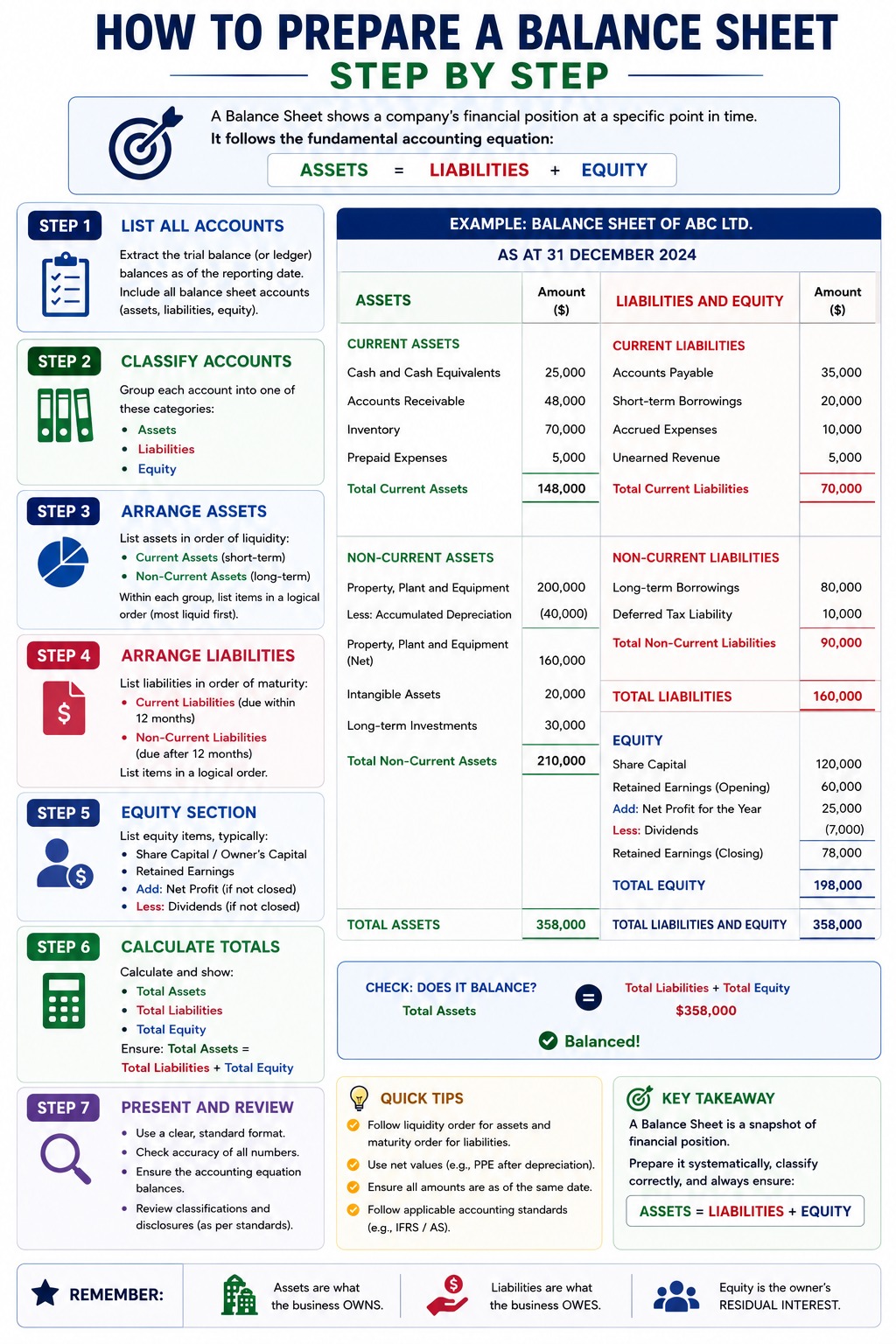
The balance sheet (called the statement of financial position under IFRS) is a snapshot of what a business owns, what it owes, and what belongs to its owners at a single point in time. It rests on one unbreakable equation:
Assets = Liabilities + Equity
If your statement doesn't balance, something is wrong — every time. Here's how to build one correctly, step by step.
Step 1: Start from an adjusted trial balance
A balance sheet is only as good as the numbers feeding it. Make sure all adjusting entries — depreciation, accruals, prepayment expirations — are posted first. The trial balance must balance before you start classifying anything.
Step 2: Classify every account
Go through the trial balance and tag each account as an asset, a liability, or equity. Revenues and expenses don't appear on the balance sheet directly — they've already been folded into equity through net income (via retained earnings or owner's capital).
Step 3: Split current from non-current
This classification is what makes a balance sheet useful to readers:
- Current assets — expected to convert to cash or be used within one year (or one operating cycle): cash, accounts receivable, inventory, prepaid expenses.
- Non-current assets — held longer than a year: property, plant & equipment (less accumulated depreciation), intangibles, long-term investments.
- Current liabilities — due within one year: accounts payable, salaries payable, unearned revenue, the current portion of long-term debt.
- Non-current liabilities — due later than one year: bank loans, bonds payable, lease liabilities.
One frequent exam trap: a 5-year loan with an instalment due next quarter must be split — the next 12 months of principal is a current liability, the rest non-current.
Step 4: Order the sections
Presentation differs slightly by framework:
- US GAAP convention lists assets in order of liquidity: current assets first, starting with cash.
- IFRS permits either order; many IFRS statements present non-current assets first. Both are acceptable — consistency is what matters.
Step 5: Compute the equity section
For a sole proprietorship:
Ending capital = Opening capital + Net income − Drawings
For a company: share capital + retained earnings (opening retained earnings + net income − dividends).
Step 6: Total, compare, and investigate
Total assets must equal total liabilities plus equity. If they don't, the discrepancy amount itself is a clue:
- Difference divisible by 2 → an amount may be on the wrong side.
- Difference divisible by 9 → likely a transposition error (e.g. 540 typed as 450).
- Difference equals one account's balance exactly → that account was omitted.
Worked example
From this adjusted trial balance: Cash 8,000 · Accounts Receivable 5,000 · Inventory 7,000 · Equipment 20,000 · Accumulated Depreciation 4,000 · Accounts Payable 6,000 · Bank Loan (due in 3 years) 12,000 · Capital 18,000.
| Statement of Financial Position | $ | |
|---|---|---|
| ASSETS | ||
| Current assets | ||
| Cash | 8,000 | |
| Accounts receivable | 5,000 | |
| Inventory | 7,000 | |
| Non-current assets | ||
| Equipment (net of 4,000 depreciation) | 16,000 | |
| Total assets | 36,000 | |
| LIABILITIES & EQUITY | ||
| Accounts payable (current) | 6,000 | |
| Bank loan (non-current) | 12,000 | |
| Owner's capital | 18,000 | |
| Total liabilities & equity | 36,000 | |
It balances: 36,000 = 36,000. Note how equipment appears net of accumulated depreciation — showing the gross 20,000 as an asset total is another classic mistake.
When it does not balance: how to find the error
Almost everyone's first balance sheet fails to balance, and hunting the difference at random wastes more time than the preparation did. The size and shape of the gap usually names the error.
Divide the difference by two. If the result matches an account on your list, you have put that account on the wrong side. An item of 3,400 placed among liabilities instead of assets shifts the totals apart by 6,800 — so a 6,800 gap points straight at a 3,400 misclassification.
Check whether the difference is divisible by nine. If it is, suspect a transposition: 5,400 entered as 4,500, or 1,260 as 1,620. Digit swaps always produce a difference that is a multiple of nine, which is one of the more useful arithmetic accidents in bookkeeping.
Look for the difference itself as a balance. A gap that exactly equals an account on the trial balance usually means that account was simply left out.
If none of those land, work backwards through the mechanical steps rather than re-reading the statement: confirm the trial balance itself balanced before you started, confirm every account was used exactly once, then re-add each column. A statement built from an unbalanced trial balance will never balance, and no amount of reclassification will fix it.
The classifications people actually get wrong
Most accounts classify themselves. A handful do not, and they are where marks are lost.
- The current portion of a long-term loan. A five-year loan repayable in instalments is not entirely non-current. Whatever falls due within twelve months is a current liability, and the rest stays non-current. Splitting it is the expected treatment, not an optional refinement.
- Bank overdraft. Repayable on demand, so it is a current liability — not negative cash. Netting it against a positive balance at another bank is only permitted where a legal right of set-off exists.
- Prepaid expenses. An asset, however strongly the word "expense" pulls the other way. You have paid for a future benefit you have not consumed yet.
- Unearned revenue. A liability, for the mirror reason. Cash was received for something not yet delivered, so you owe goods or service rather than money.
- Accumulated depreciation. Never a liability. It is a contra asset, deducted from the asset it relates to, and showing it among liabilities is a classic way to make a statement balance for entirely the wrong reason.
- Owner drawings. A reduction of equity, not an expense and not an asset.
The current versus non-current split rests on one test: is the item expected to be realised or settled within the normal operating cycle or twelve months, whichever is longer. Applying that test deliberately to each doubtful item is faster than trying to recall a list.
Reading what you have prepared
A balance sheet that balances is arithmetically complete, not necessarily sensible, and a short review catches errors the totals never will.
Compare current assets with current liabilities. If current liabilities exceed current assets, the business may struggle to meet its obligations as they fall due — worth a second look at whether the split was made correctly before drawing that conclusion. Check that no asset carries a credit balance and no liability a debit balance. Confirm accumulated depreciation is smaller than the cost of the assets it relates to; if it is larger, the asset has been depreciated below zero.
Then check equity moves the way it should: opening equity, plus profit for the period, less drawings or dividends, should reconcile to the closing figure. If it does not, either something has been posted directly to equity that should have gone through profit, or the closing figure was plugged.
What the statement does not tell you
The balance sheet is a position at a single instant, and reading it as though it described the business generally leads people astray in three specific ways.
It is a snapshot, so a date chosen just after a large collection looks very different from one chosen just before. It is built largely on historical cost, so a property bought decades ago sits at a figure bearing no relation to what it would fetch today — the totals are not a valuation of the business. And it omits anything that cannot be measured reliably: an experienced workforce, a strong brand built internally, a loyal customer base. Those often matter more than what is on the page, and none of them appear.
Practice it until it's automatic
Classification speed comes only from repetition. Accountely's balance sheet challenges give you a trial balance and grade your classified statement line by line — including whether your current/non-current splits and subtotals are right. Start with the easy ones and work up.