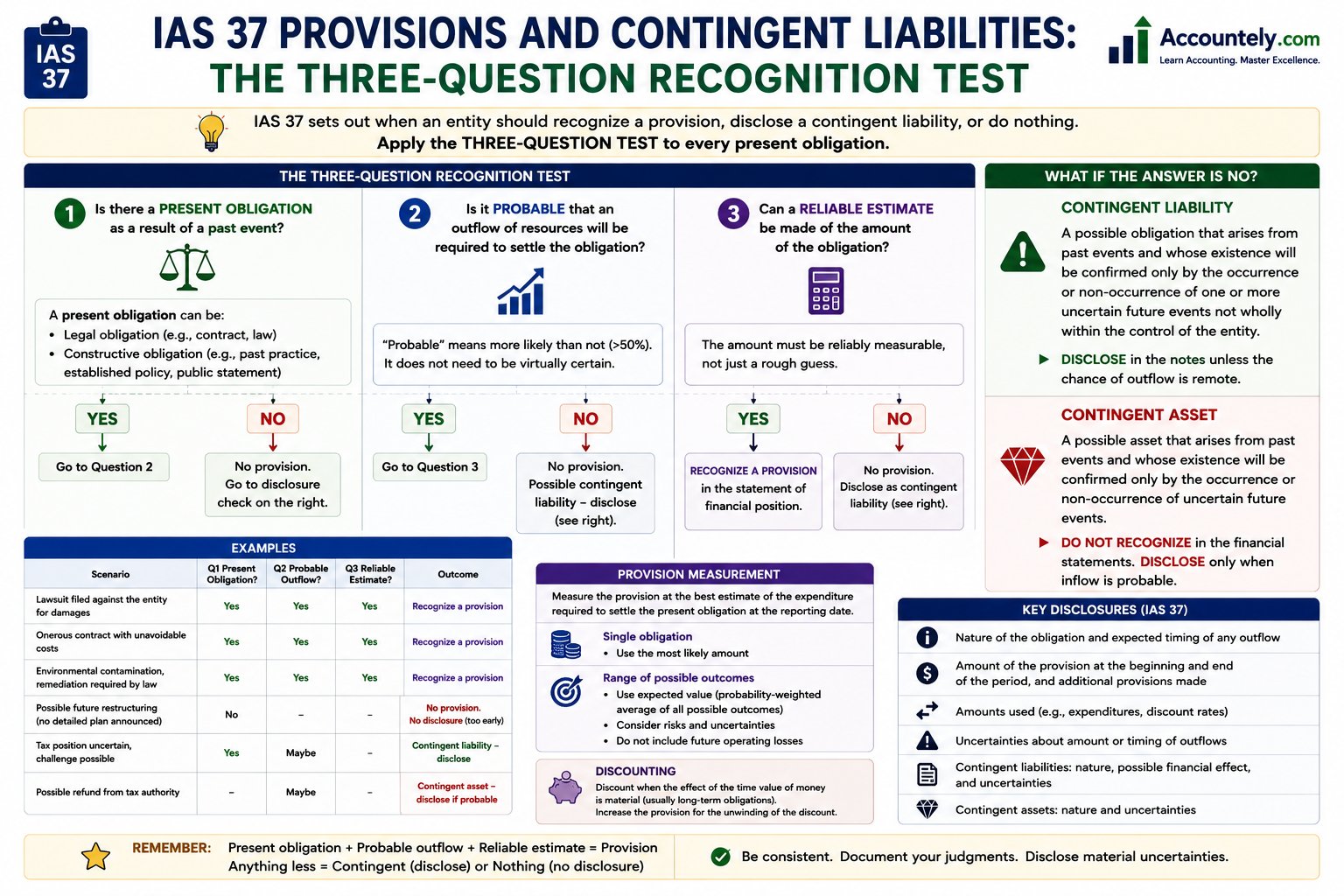
IAS 37 answers a question that comes up constantly in practice: a company might owe money because of something that happened, but the amount and timing are uncertain — a lawsuit, a warranty, a restructuring. Does that get recorded as a liability, mentioned in a footnote, or ignored? IAS 37 settles it with a three-question test.
The Three-Question Recognition Test
A provision is recognised only when all three of these are true:
1. There is a present obligation (legal or constructive) as a result of a past event
2. It is probable (more likely than not) that an outflow of resources will be required to settle it
3. The amount can be reliably estimated
If all three are met, recognise a provision — a real liability on the balance sheet. If an outflow is only possible rather than probable (or the obligation isn't yet certain), it's a contingent liability — disclosed in the notes, but not recognised. If the outflow is remote, it's neither recognised nor disclosed.
Worked Example: A Warranty Provision
A company sold $2,000,000 of product during the year, covered by a one-year warranty. Based on historical claims data, it estimates warranty costs at 3% of sales.
Sales: $2,000,000
Estimated warranty rate: 3%
Provision required: $60,000
Journal entry:
Dr Warranty Expense — $60,000
Cr Warranty Provision — $60,000
All three recognition conditions are met here: the obligation exists the moment the product is sold under warranty (past event), a payout is probable based on history, and historical claims data makes the amount reliably estimable.
Contingent Assets Get the Opposite Treatment
IAS 37 is deliberately asymmetric. A contingent asset — say, a lawsuit the company is probably going to win — is only disclosed once the inflow is probable, and only recognised once it becomes virtually certain. Compare that to contingent liabilities, which get disclosed at the much lower "possible" threshold. The standard is built to avoid a company recognising gains before they're all but guaranteed, while still capturing likely losses early — conservatism baked directly into the recognition thresholds.
One Specific Case Worth Knowing: Onerous Contracts
IAS 37 explicitly addresses onerous contracts — contracts where the unavoidable costs of meeting the obligations exceed the economic benefits expected from it. When that happens, the entity recognises a provision for the excess: the lower of the cost of fulfilling the contract and the cost of exiting it (e.g. penalties for cancellation).
Where Marks Are Usually Lost
- Recognising a provision on "possible" rather than "probable." Possible means disclosure only — recognition needs the higher probable threshold.
- Recognising a contingent gain the moment it looks probable. Contingent assets don't get recognised until virtually certain, even though contingent liabilities are disclosed at the lower probable/possible threshold — the asymmetry is deliberate, not a typo in the standard.
- Treating "obligation" as needing a signed contract. A constructive obligation — created by an established pattern of past practice or a published policy the entity can't realistically walk back from — counts too.
- Skipping the onerous contract test. A loss-making contract still in progress needs its own provision for the unavoidable excess, separate from any warranty or legal provisions already recognised.
Provisions questions are really about classification first, measurement second — most wrong answers come from stopping at "is this probable?" without checking whether the amount is even reliably estimable. Accountely's provisions & contingencies challenges test both steps, with feedback on the recognition decision separately from the number itself.