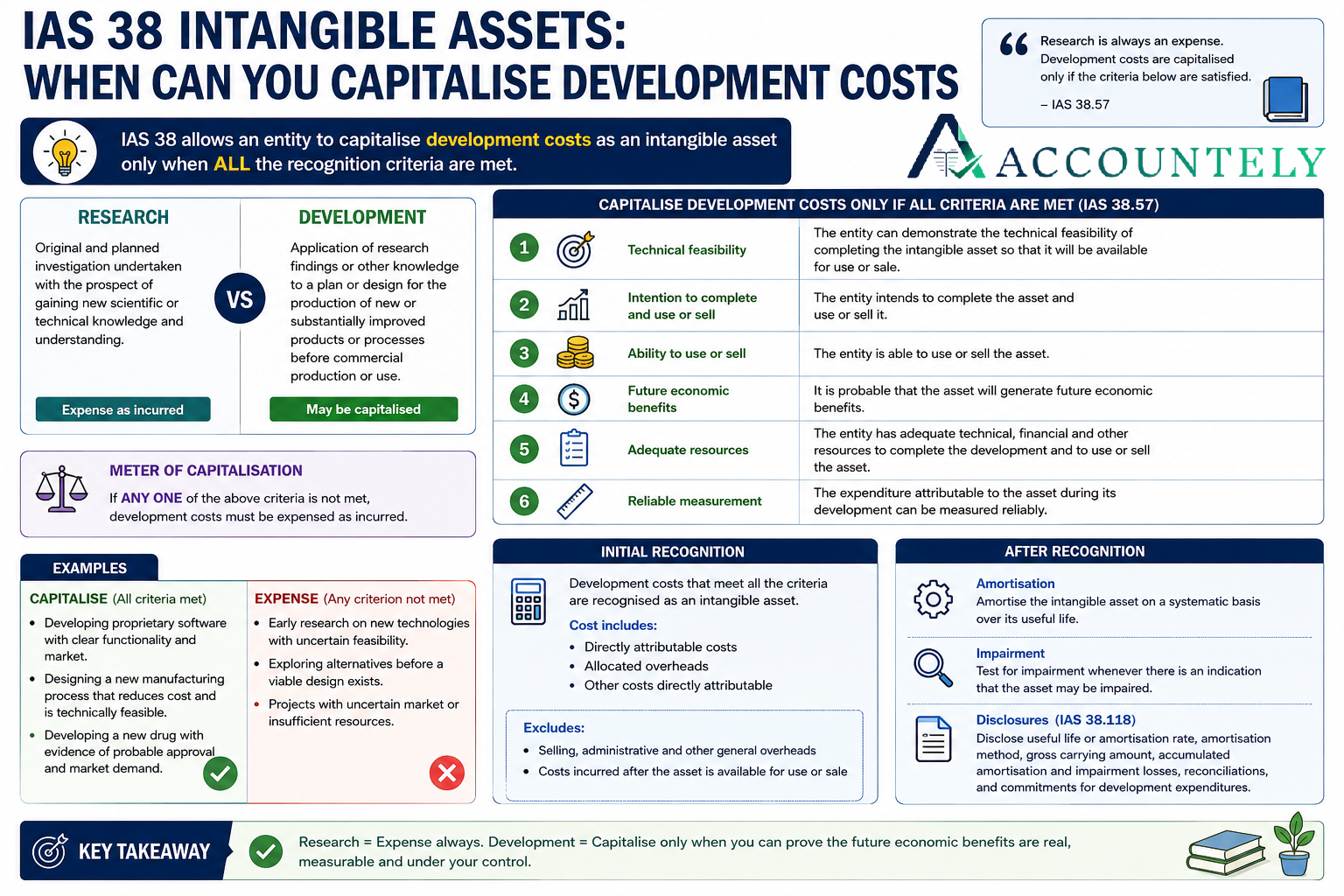
IAS 38 is mostly a standard about saying no. Companies spend enormous sums on brands, training, customer lists and research, and IAS 38's default answer to "can we capitalise that?" is no. Understanding the standard means understanding the narrow gate that expenditure has to pass through, and the one genuinely important exception: development costs.
The Definition and the Recognition Criteria
An intangible asset is an identifiable non-monetary asset without physical substance. Three words carry the weight:
Identifiable — it is either separable (capable of being sold, transferred or licensed independently) or arises from contractual or other legal rights. This is the test internally generated goodwill fails, because you cannot sell a company's reputation apart from the company.
Control — the entity has the power to obtain future economic benefits and restrict others' access to them. A trained workforce fails here: staff can resign, so the entity doesn't control the benefit.
Future economic benefits — revenue, or cost savings.
On top of the definition, recognition requires that it is probable the expected benefits will flow to the entity, and that the cost can be measured reliably.
Research vs Development: The Line That Matters
IAS 38 splits internal projects in two, and treats the halves oppositely.
Research — original and planned investigation undertaken with the prospect of gaining new scientific or technical knowledge. Research expenditure is always expensed as incurred. No exceptions, no capitalisation, however promising the project.
Development — the application of research findings to a plan or design for the production of new or substantially improved materials, devices, products or processes. Development costs must be capitalised — not may — once all six criteria are met.
The Six Development Criteria
All six must be demonstrated. The standard mnemonic is PIRATE:
P — Probable future economic benefits will flow
I — Intention to complete the asset and use or sell it
R — Resources (technical, financial and other) adequate to complete it
A — Ability to use or sell the asset
T — Technical feasibility of completing it
E — Expenditure attributable to the asset can be measured reliably
Capitalisation starts from the date all six are first met — and not a day earlier. Expenditure already expensed in an earlier period cannot be reinstated as an asset once the criteria are subsequently satisfied. That prohibition is explicit, and it is a favourite exam trap.
Worked Example
A company spends the following on a new product during 2026:
- Jan–Apr: $300,000 investigating whether a new compound is viable
- May–Jun: $150,000 refining the design; the six criteria are met from 1 July
- Jul–Dec: $480,000 building and testing the production prototype
Treatment:
Jan–Apr $300,000 — research, expensed
May–Jun $150,000 — incurred before the criteria were met, expensed and cannot be reinstated
Jul–Dec $480,000 — capitalised as an intangible asset
Dr Intangible Asset — Development Costs — $480,000
Cr Cash / Payables — $480,000
Total expensed: $450,000. Capitalised: $480,000. The instinct to capitalise the full $630,000 spent after research ended is the error the $150,000 is there to catch.
What Can Never Be Capitalised
IAS 38 explicitly prohibits recognising these as assets, however much was spent:
- Internally generated goodwill — not identifiable
- Internally generated brands, mastheads, publishing titles and customer lists — indistinguishable from the cost of developing the business as a whole
- Start-up, pre-opening and pre-operating costs
- Training expenditure — no control over the workforce
- Advertising and promotional activities
- Relocation or reorganisation costs
Note the asymmetry that surprises people: a brand purchased in a business combination is recognised at fair value, while the identical brand built internally is expensed. IAS 38 tolerates this because an arm's length transaction supplies the reliable measurement that internal development cannot.
Amortisation: Finite vs Indefinite
An intangible with a finite useful life is amortised over that life, beginning when the asset is available for use. The residual value is assumed to be zero unless there is a commitment by a third party to buy the asset, or an active market exists for it.
An intangible with an indefinite useful life is not amortised. "Indefinite" does not mean infinite — it means there is no foreseeable limit to the period over which the asset is expected to generate net cash inflows. Instead, it is tested for impairment annually under IAS 36, and the indefinite assessment is itself reviewed each period.
Where Marks Are Usually Lost
- Capitalising research costs. Always expensed, no matter how promising the results.
- Reinstating previously expensed costs once the criteria are met. Explicitly prohibited — capitalisation is forward-looking only.
- Treating development capitalisation as optional. Once all six criteria are met, capitalisation is mandatory.
- Amortising an indefinite-life intangible. It gets an annual impairment test instead.
- Assuming a residual value. Default is zero, absent a purchase commitment or active market.
- Capitalising an internally generated brand. Prohibited, even where the spend is enormous and the brand is demonstrably valuable.
Most IAS 38 questions are really date questions — the marks sit in identifying the exact point the six criteria were met and splitting the spend around it. Accountely's intangible assets challenges test the research/development split and the amortisation separately, so a mis-drawn line doesn't cost you the whole question. Since indefinite-life intangibles route straight into an annual impairment test, the impairment challenges are the natural next set.