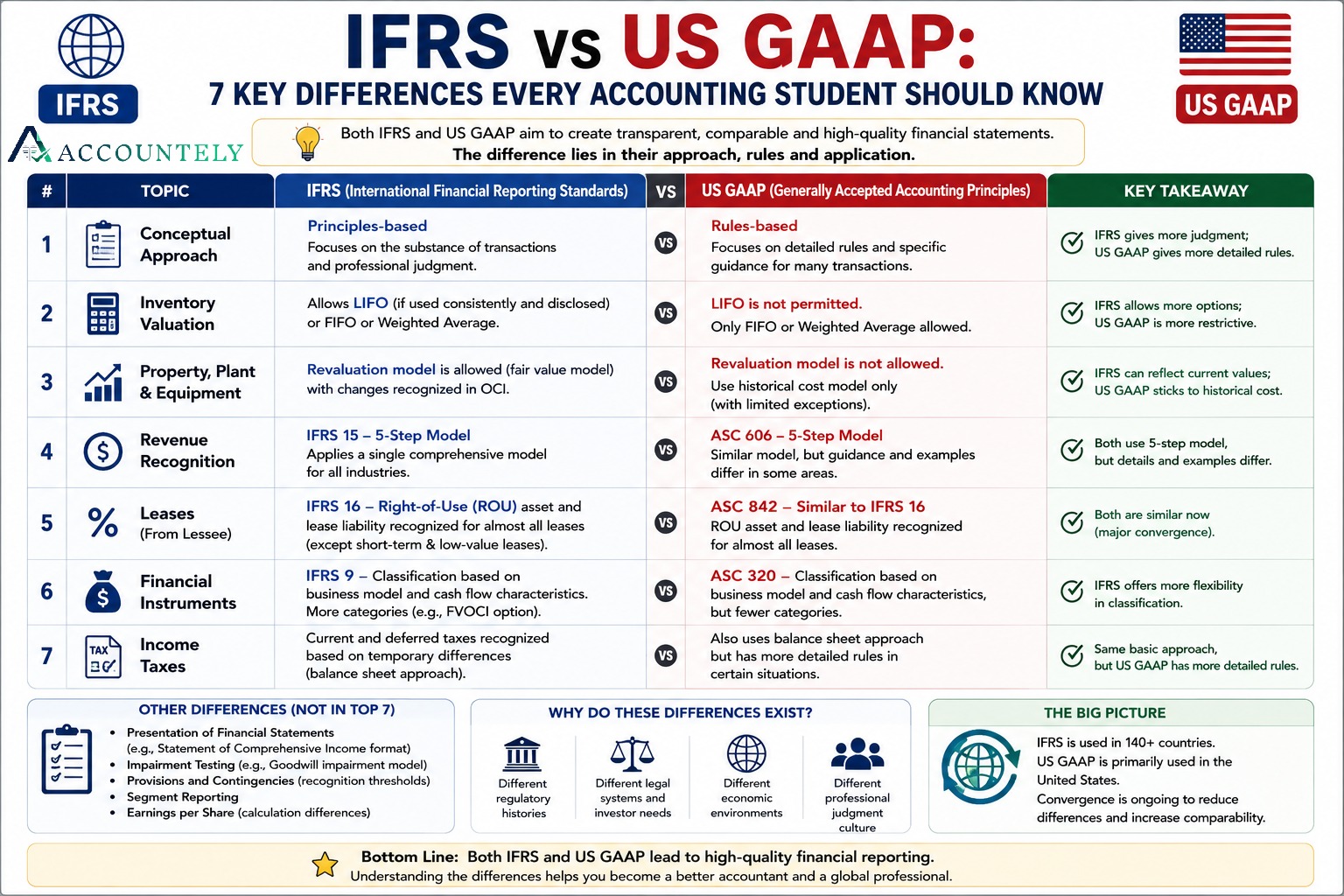
IFRS and US GAAP are the two dominant financial reporting frameworks in the world, and while they agree on the vast majority of principles, the differences that remain are exactly the ones exam questions (and real-world M&A due diligence) love to test. Here are the seven that come up most often.
1. Inventory Costing: LIFO
US GAAP permits the last-in, first-out (LIFO) inventory costing method. IFRS prohibits it outright under IAS 2 — only FIFO and weighted-average cost are allowed. This is one of the most frequently tested differences, because it directly affects both cost of goods sold and ending inventory value during periods of changing prices.
2. Reversal of Inventory Write-Downs
If inventory was previously written down below cost and its value later recovers, IFRS allows the write-down to be reversed (up to the original cost). US GAAP prohibits reversing an inventory write-down once it's been recorded — once written down, that lower value sticks even if the market recovers.
3. Development Costs
IAS 38 requires development costs to be capitalised once specific criteria are met (technical feasibility, intent and ability to complete, probable future economic benefit, and so on) — research costs are still expensed. US GAAP generally requires all research and development costs to be expensed as incurred, with only a few narrow exceptions such as certain internal-use software costs.
4. Revaluation of Property, Plant & Equipment
IFRS (IAS 16) permits companies to use the revaluation model for property, plant, and equipment — carrying assets at fair value with periodic revaluations, not just historical cost. US GAAP does not allow revaluation of PP&E at all; assets stay at historical cost less accumulated depreciation, full stop.
5. Lease Accounting
Both frameworks now put almost all leases on the balance sheet as a right-of-use asset and lease liability, but they diverge on the income statement. IFRS 16 uses a single lessee model — nearly every lease is treated like a finance lease. US GAAP (ASC 842) keeps a dual model for lessees, still distinguishing between operating leases (straight-line expense) and finance leases (separate interest and amortisation expense).
6. Extraordinary Items
US GAAP used to allow companies to separately classify highly unusual, infrequent items as "extraordinary" on the income statement — though this was eliminated by an accounting standards update in 2015 to reduce complexity. IFRS has never permitted an extraordinary item classification; unusual items are simply presented within normal operating results, with disclosure in the notes.
7. Balance Sheet Presentation
Neither framework strictly mandates an order, but the conventions differ. IFRS balance sheets commonly present non-current items first, then current (least liquid to most liquid). US GAAP balance sheets conventionally present current items first, then non-current (most liquid to least liquid). The naming differs too — IFRS technically calls it a "statement of financial position," while GAAP simply calls it a "balance sheet."
The Bigger Picture: Principles-Based vs Rules-Based
Beyond these specific differences, IFRS is generally described as principles-based — broader standards that rely on judgement to apply — while US GAAP is more rules-based, with far more detailed, prescriptive guidance for specific situations. That underlying philosophy is often the reason the specific differences above exist in the first place.
Accountely's challenges are built primarily around IFRS, with US GAAP terminology recognised where the two frameworks describe the same concept differently — so you can practice the standard your course actually teaches. Browse all challenge types to start applying these differences to real problems.