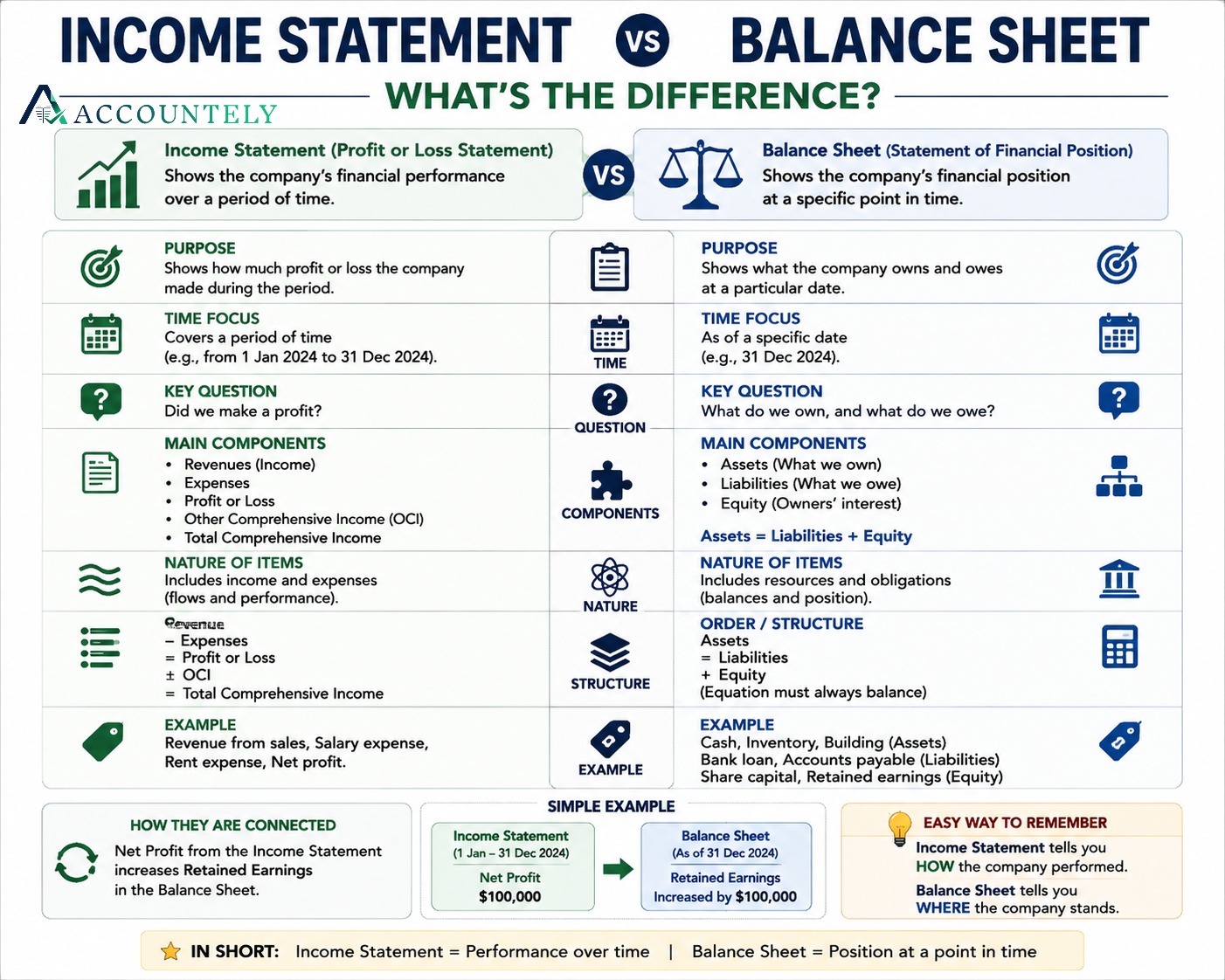
These are the two financial statements every accounting student meets first, and it's genuinely easy to blur them together early on — both are full of numbers, both come from the same trial balance, and both matter to investors. But they answer fundamentally different questions.
The One-Sentence Difference
The income statement shows whether the business was profitable over a period of time. The balance sheet shows what the business owns and owes at a single point in time.
Period vs Point in Time
This is the difference that matters most and the one students misapply most often. An income statement is always labelled "for the year ended" or "for the month ended" — it's a flow, measuring activity across a stretch of time. A balance sheet is always labelled "as at" a specific date — it's a snapshot, like a photograph of the business's financial position on that one day.
What Each Statement Contains
Income Statement
- Revenue — what was earned during the period
- Cost of goods sold and operating expenses — what it cost to earn that revenue
- Net income (or loss) — revenue minus expenses
Balance Sheet
- Assets — what the business owns or controls
- Liabilities — what the business owes
- Equity — the owners' residual claim (assets minus liabilities)
How They Connect
They're not independent — net income from the income statement flows directly into retained earnings on the balance sheet. That's the thread that ties every financial statement together: the income statement explains why equity changed between two balance sheet dates. Without that link, the accounting equation (Assets = Liabilities + Equity) wouldn't hold across periods.
A Side-by-Side Example
Imagine a business earns $50,000 in revenue and incurs $35,000 in expenses during the year. The income statement reports net income of $15,000 for that year — a flow.
At year-end, the balance sheet might show total assets of $120,000 financed by $70,000 of liabilities and $50,000 of equity. That $50,000 in equity includes the $15,000 net income just earned, added to whatever equity existed at the start of the year — a snapshot, at that exact date.
A Quick Way to Tell Them Apart on Sight
If a heading says "for the year/month ended," you're looking at a flow statement — income statement (or cash flow statement). If it says "as at" or "as of" a date, you're looking at a snapshot — the balance sheet.
Once the distinction clicks, the rest of financial statement preparation gets much easier — the balance sheet at the start of a period, plus everything that happened (the income statement), equals the balance sheet at the end. Build both from scratch with instant feedback using Accountely's income statement and balance sheet practice challenges.