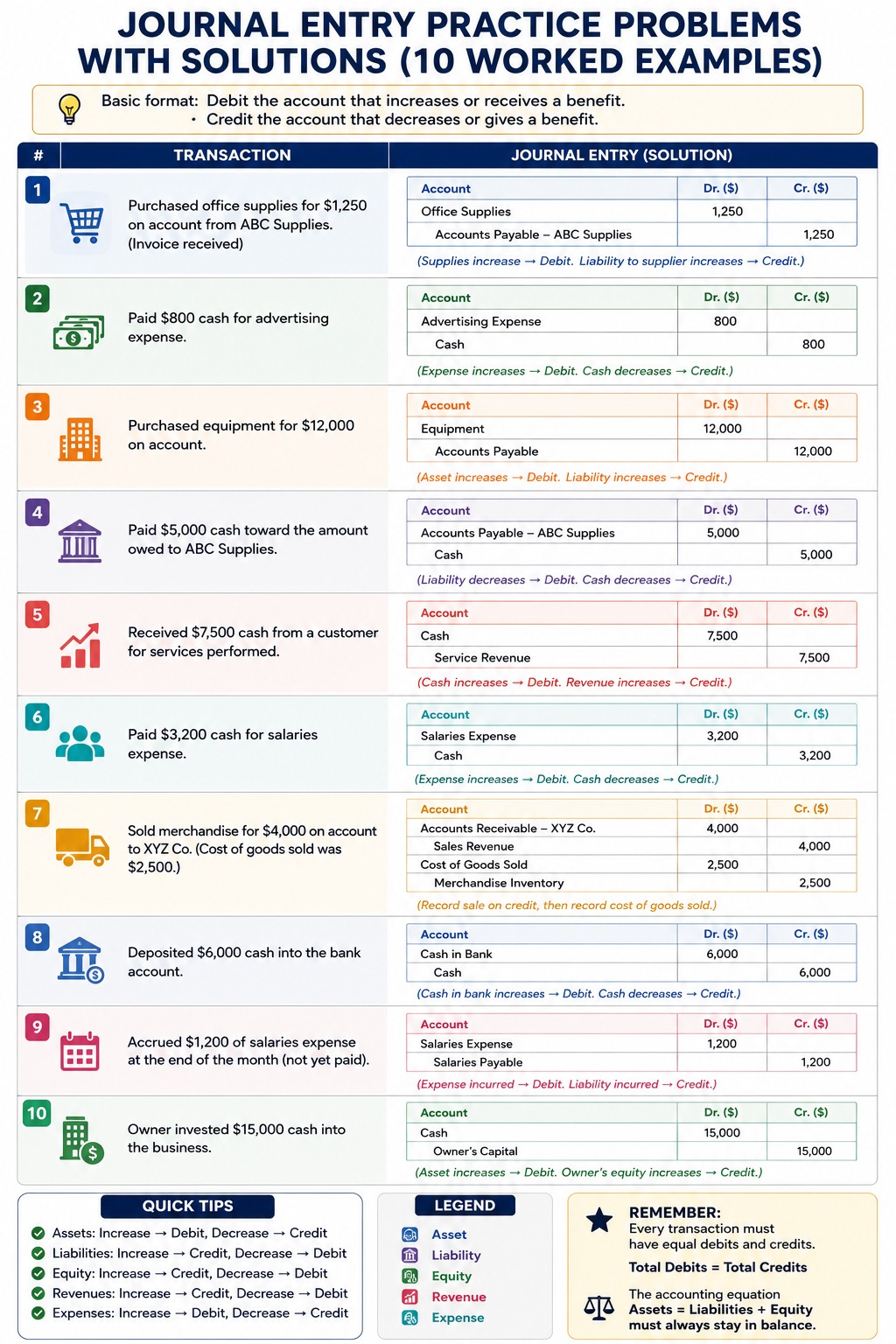
The fastest way to get comfortable with journal entries is not reading theory — it's working through problems and checking your reasoning against a correct solution. Below are ten classic transactions, each with the journal entry and a short explanation of why each account is debited or credited.
Before you start, remember the golden rule: debits must always equal credits, and every entry answers two questions — what did the business receive, and what did it give up?
Problem 1: Owner invests cash
The owner invests $50,000 cash to start the business.
| Account | Debit | Credit |
|---|---|---|
| Cash | 50,000 | |
| Owner's Capital | 50,000 |
Why: Cash (an asset) increases → debit. The owner's claim on the business (equity) increases → credit.
Problem 2: Buying equipment partly on credit
The business buys equipment for $12,000, paying $4,000 cash and the rest on account.
| Account | Debit | Credit |
|---|---|---|
| Equipment | 12,000 | |
| Cash | 4,000 | |
| Accounts Payable | 8,000 |
Why: One debit can be matched by several credits — this is a compound entry. Equipment rises by the full cost; cash falls by what was paid; the unpaid remainder becomes a liability.
Problem 3: Service revenue earned for cash
The business performs services and collects $3,500 immediately.
| Account | Debit | Credit |
|---|---|---|
| Cash | 3,500 | |
| Service Revenue | 3,500 |
Why: Revenue increases equity, and equity increases on the credit side — so revenue is always credited when earned.
Problem 4: Service revenue on account
The business bills a client $2,000 for completed work; payment is due in 30 days.
| Account | Debit | Credit |
|---|---|---|
| Accounts Receivable | 2,000 | |
| Service Revenue | 2,000 |
Why: Under accrual accounting, revenue is recognised when earned, not when cash arrives. The client's promise to pay is an asset: accounts receivable.
Problem 5: Collecting the receivable
The client from Problem 4 pays the $2,000 owed.
| Account | Debit | Credit |
|---|---|---|
| Cash | 2,000 | |
| Accounts Receivable | 2,000 |
Why: No revenue here! Revenue was recognised in Problem 4. This entry simply swaps one asset (receivable) for another (cash). Double-counting revenue at collection is one of the most common student errors.
Problem 6: Paying rent in advance
The business pays $6,000 for six months of rent up front.
| Account | Debit | Credit |
|---|---|---|
| Prepaid Rent | 6,000 | |
| Cash | 6,000 |
Why: Paying in advance buys a future benefit, which is an asset (prepaid rent), not an expense — yet. Each month, $1,000 will be moved from the asset to rent expense as the benefit is used up.
Problem 7: The monthly rent adjustment
One month has passed since the prepayment in Problem 6.
| Account | Debit | Credit |
|---|---|---|
| Rent Expense | 1,000 | |
| Prepaid Rent | 1,000 |
Why: This is an adjusting entry. One month of the prepaid benefit has been consumed, so $1,000 leaves the asset and becomes an expense.
Problem 8: Unearned revenue received
A customer pays $4,800 in advance for a 12-month service contract.
| Account | Debit | Credit |
|---|---|---|
| Cash | 4,800 | |
| Unearned Revenue | 4,800 |
Why: Cash received before the work is done is not revenue — it's an obligation to deliver services, i.e. a liability. Revenue will be recognised month by month as the service is provided.
Problem 9: Accrued salaries
At month-end, employees have earned $2,700 in wages that will be paid next month.
| Account | Debit | Credit |
|---|---|---|
| Salaries Expense | 2,700 | |
| Salaries Payable | 2,700 |
Why: The expense belongs to the period in which employees worked, even though cash moves later. The unpaid amount is a liability until payday.
Problem 10: Owner withdraws cash
The owner withdraws $1,500 for personal use.
| Account | Debit | Credit |
|---|---|---|
| Owner's Drawings | 1,500 | |
| Cash | 1,500 |
Why: Drawings reduce equity but are not an expense — they aren't incurred to generate revenue. They sit in a separate contra-equity account.
A method that works on any entry
The ten problems above are solvable by recognition once you have seen enough of them. Unfamiliar transactions need a method rather than recall, and the same four questions handle almost anything.
- What did the business receive, and what did it give up? Every transaction is an exchange. Naming both halves stops you writing a one-sided entry.
- Which accounts do those two things belong to? Be specific. "Money" is not an account; Cash, Bank and Accounts Receivable are, and they behave differently.
- What type is each account? Asset, liability, equity, revenue or expense. This is the only step that decides the sides.
- Is each one going up or down? Apply the rule: assets and expenses increase on the debit side, liabilities, equity and revenue increase on the credit side.
Then check the totals agree before moving on. Working in that order means you never guess a side — the side is a consequence of the answers to steps three and four, not a decision of its own.
Five harder problems
Problem 11: Buying equipment with a trade-in
Equipment costing $30,000 is bought. The supplier accepts an old machine valued at $4,000 in part exchange, with the balance paid in cash. The old machine originally cost $12,000 and had accumulated depreciation of $9,000.
The old machine's carrying amount is $12,000 less $9,000, or $3,000. It was accepted for $4,000, so there is a gain of $1,000.
Debit Equipment (new) 30,000; debit Accumulated Depreciation 9,000; credit Equipment (old) 12,000; credit Gain on Disposal 1,000; credit Cash 26,000. Five lines, and the totals agree at 39,000 each side. The accumulated depreciation must be removed along with the asset — leaving it behind is the usual error here.
Problem 12: Recording a sale with a discount offered
Goods are sold for $8,000 on terms of 2/10, net 30. The customer pays within ten days.
At the sale: debit Accounts Receivable 8,000, credit Sales Revenue 8,000. On collection the customer pays $7,840 and takes the $160 discount: debit Cash 7,840; debit Sales Discounts 160; credit Accounts Receivable 8,000.
Sales Discounts is a contra revenue account with a debit balance, not an expense. It reduces net sales rather than sitting among operating costs.
Problem 13: Writing off a bad debt under the allowance method
A $2,500 balance is judged uncollectible. An allowance already exists.
Debit Allowance for Doubtful Accounts 2,500; credit Accounts Receivable 2,500. No expense appears, because the expense was recognised when the allowance was created. Debiting Bad Debt Expense here counts the same loss twice — the most common mistake in the topic.
Problem 14: Issuing shares above par
1,000 shares with a par value of $1 are issued at $12 each.
Debit Cash 12,000; credit Share Capital 1,000; credit Share Premium 11,000. Only the par amount goes to share capital; the excess is a separate account because the two have different legal characters. Crediting the whole $12,000 to share capital is wrong even though it balances.
Problem 15: Correcting an error found later
A $600 repair was debited to the Equipment account by mistake.
The account that should have been used is Repairs Expense, and the one wrongly used is Equipment. Debit Repairs Expense 600; credit Equipment 600. Correcting entries follow the same logic as any other: work out what should have happened, compare it with what did, and post the difference. Reversing the original entry in full and re-posting it correctly also works and is easier to follow when the original was more complicated.
If an entry will not balance
When your debits and credits disagree, the cause is usually one of a small number of things. You have recorded only one side of the exchange. You have applied the rule to the wrong account type — treating a payable as an asset, or drawings as an expense. You have missed a line in a compound entry, which happens most often with disposals, where accumulated depreciation is easy to forget. Or the amounts are right and the arithmetic is not.
Checking in that order is faster than re-reading the question, because each cause produces a recognisable gap rather than a random one.
How did you do?
If you got 8 or more right on your first attempt, you're ready for harder material — try adjusting entries, depreciation, and multi-step transactions. If some of these tripped you up, that's exactly what practice is for.
Reading solutions builds familiarity. Solving problems yourself — and getting instant, line-by-line feedback — builds skill.
Accountely has a full bank of journal entry challenges that grade every line of your answer automatically and explain what you missed, plus a structured 30-day learning path if you want to build up from the basics. It's free to start.