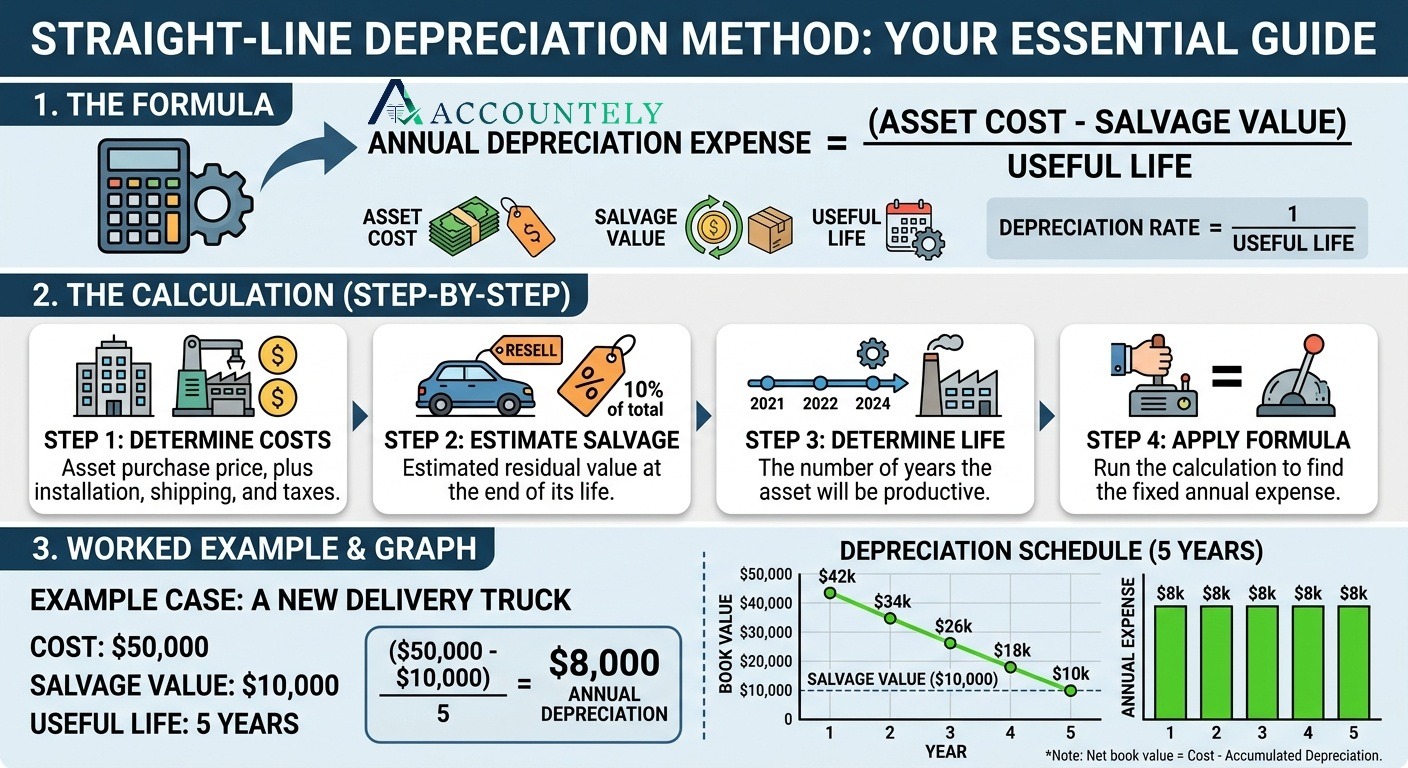
Straight-line depreciation is the first method every accounting student learns, and for good reason — it's the most widely used method in practice, and the math behind it is simple once you see the formula laid out with real numbers.
What Is Straight-Line Depreciation?
Depreciation spreads the cost of a fixed asset over its useful life, matching the expense to the periods that actually benefit from using the asset — instead of expensing the entire cost the moment it's purchased. The straight-line method spreads that cost evenly across every period, producing the same depreciation expense year after year.
The Formula
Annual Depreciation Expense = (Cost − Residual Value) ÷ Useful Life
- Cost — the full purchase price, including costs necessary to get the asset ready for use (delivery, installation, etc.)
- Residual value (also called salvage value) — the estimated amount the asset could be sold for at the end of its useful life
- Useful life — the estimated number of periods the asset will be used
Worked Example
A company buys a delivery van for $32,000. It's expected to be used for 6 years, after which it can be sold for an estimated $2,000.
Annual depreciation = ($32,000 − $2,000) ÷ 6 = $5,000 per year
Every year for 6 years, the company recognises exactly $5,000 of depreciation expense — never more, never less, regardless of how much the van was actually used that particular year.
The Journal Entry
Dr Depreciation Expense $5,000 — Cr Accumulated Depreciation $5,000
Accumulated Depreciation is a contra-asset account — it's presented on the balance sheet as a deduction from the asset's original cost, not as its own separate liability. After year 3, the van's net book value (also called carrying value) would be: $32,000 cost − $15,000 accumulated depreciation = $17,000.
Straight-Line vs Other Depreciation Methods
Straight-line isn't the only method — it's just the simplest. The declining balance method front-loads more depreciation into earlier years (useful for assets that lose value or usefulness faster early on). The units-of-production method ties depreciation to actual usage — machine hours, units produced — rather than time, so expense varies year to year based on how much the asset was actually used. Straight-line remains the default choice unless there's a specific reason an asset's benefit isn't evenly spread over time.
The Exam Trap: Partial-Year Depreciation
If an asset is purchased partway through the year, most methods (including straight-line) require depreciating only for the portion of the year the asset was actually owned. If that $32,000 van was purchased on July 1, the first year's depreciation would be:
$5,000 × (6 months ÷ 12 months) = $2,500 for that first partial year, then the full $5,000 in each subsequent full year.
Forgetting to prorate the first (and sometimes last) year is one of the single most common depreciation mistakes on exams.
Depreciation entries show up constantly in journal entry, trial balance, and balance sheet problems alike — Accountely's journal entry challenges and balance sheet challenges both test it with instant feedback on whether your calculation and entry are correct.