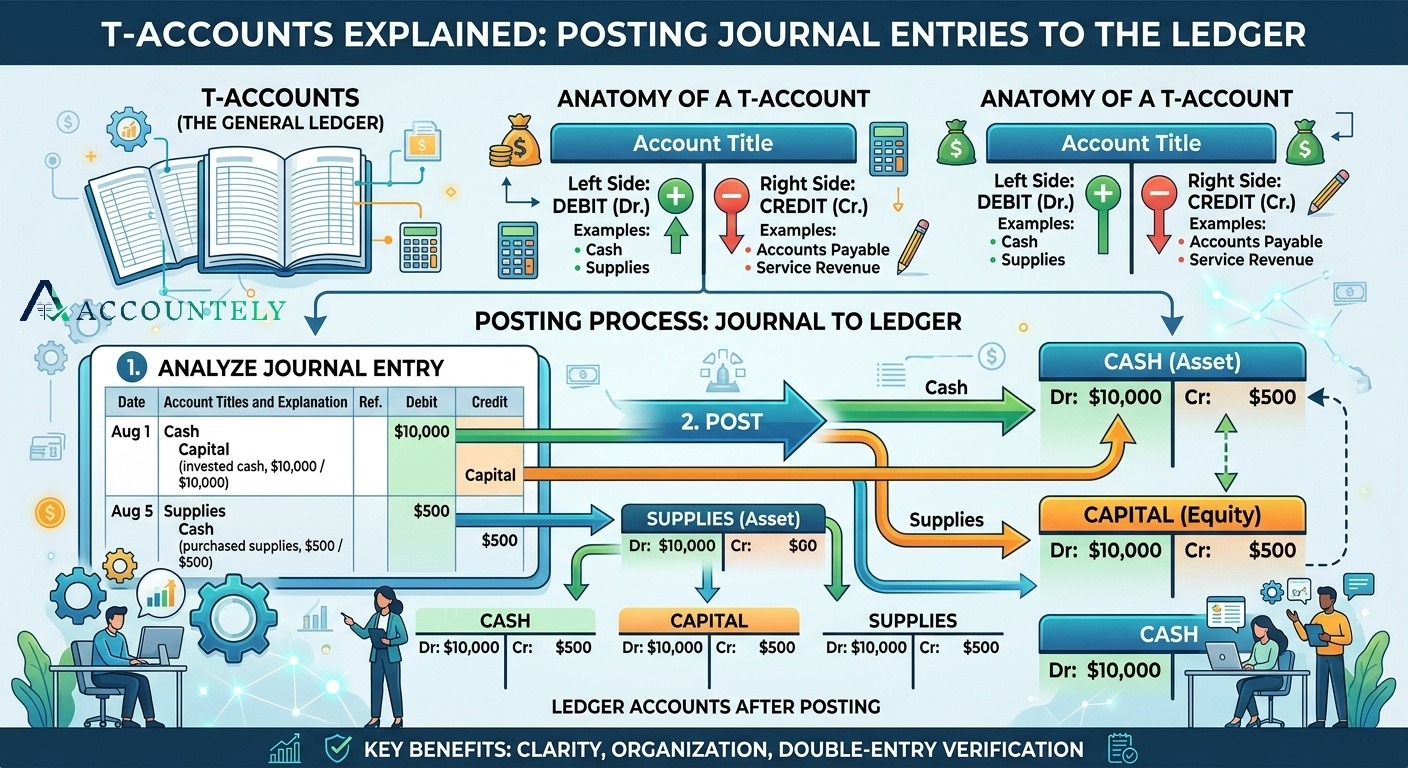
Recording a journal entry is only half the job — that entry then has to be posted to the ledger, the account-by-account record that lets you actually see an account's running balance. T-accounts are the simplified way students learn to visualise that posting process before moving on to real ledger software.
What Is a Ledger?
If the journal is a chronological diary of every transaction, the ledger is the same information reorganised by account. Every account — Cash, Accounts Receivable, Sales Revenue, and so on — gets its own page (or section) showing every debit and credit ever posted to it, and its running balance.
What Is a T-Account?
A T-account is a simplified sketch of one ledger account, shaped like a capital "T": the account name sits on top, debits are recorded on the left side, and credits are recorded on the right side.
Cash
Debit side | Credit side
------------------- | -------------------
(debits listed here) | (credits listed here)
How to Post a Journal Entry to a T-Account
Posting is mechanical: for every line of a journal entry, find that account's T-account and copy the amount to the matching side — debit lines go on the debit (left) side, credit lines go on the credit (right) side. A single journal entry always touches at least two T-accounts, one for each side of the entry.
Example journal entry: Dr Cash $2,000 — Cr Service Revenue $2,000
Posting this means: $2,000 goes on the left side of the Cash T-account, and $2,000 goes on the right side of the Service Revenue T-account.
Finding the Balance of a T-Account
Add up each side separately, then subtract the smaller total from the larger. The account's balance sits on whichever side is larger — which, for a normal, healthy account, should be its "normal" side (assets and expenses normally carry debit balances; liabilities, equity, and revenue normally carry credit balances).
A Worked Example — From Journal to Ledger
Suppose these three entries were recorded during the month:
- Dr Cash $5,000 — Cr Owner's Capital $5,000 (owner invests cash)
- Dr Rent Expense $800 — Cr Cash $800 (paid rent)
- Dr Cash $1,200 — Cr Service Revenue $1,200 (cash sale)
Posting all Cash lines to its T-account: debit side receives $5,000 and $1,200 (total $6,200); credit side receives $800. Balance = $6,200 − $800 = $5,400 debit balance — which makes sense, since Cash is an asset and assets normally carry debit balances.
T-Accounts vs Running-Balance Ledgers
T-accounts are a learning tool — real bookkeeping systems (and most exam-style ledger problems) use a running-balance format instead, where every transaction is listed on its own row with a balance column that updates immediately after each entry, rather than totalling both sides only at the end. The underlying logic is identical; running-balance ledgers just show the balance evolving line by line instead of leaving it for a final calculation.
Once you can post confidently from journal to ledger, the trial balance is just a matter of listing every account's final balance. Practice posting and running-balance ledgers directly on Accountely's ledger challenges, with feedback on every posted amount.