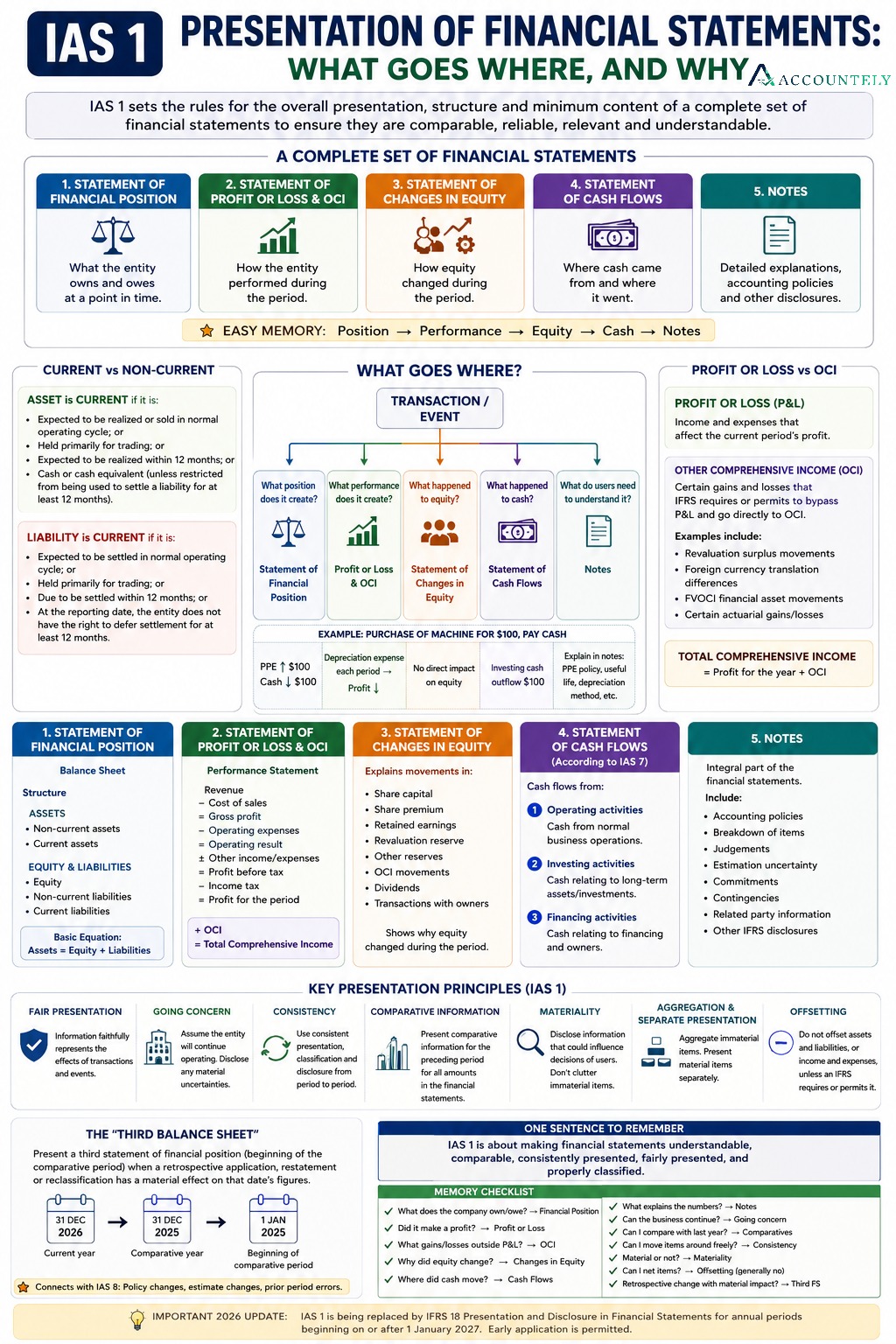
IAS 1 is the standard almost nobody reads and almost everybody is graded on. It doesn't tell you how to measure anything — no depreciation rates, no revenue rules. It tells you what a complete set of financial statements looks like, what has to appear on the face of each one, and which line items can be buried in the notes. Get IAS 1 wrong and a technically perfect set of numbers still loses marks for presentation.
What "A Complete Set of Financial Statements" Actually Means
IAS 1 defines five required components. Producing four of them is an incomplete set:
1. A statement of financial position (balance sheet) at the end of the period
2. A statement of profit or loss and other comprehensive income for the period
3. A statement of changes in equity for the period
4. A statement of cash flows for the period
5. Notes, comprising material accounting policy information and other explanatory information
Comparative information for the preceding period is required for all of these. The statement of changes in equity is the one students most often forget exists — it is not optional, and it is where share issues, dividends, and revaluation movements are reconciled.
Current vs Non-Current: The Classification That Drives the Balance Sheet
IAS 1 requires assets and liabilities to be presented split between current and non-current, unless a liquidity-based presentation is more relevant (banks, typically).
An asset is current when any of these hold:
- It is expected to be realised, sold or consumed in the entity's normal operating cycle
- It is held primarily for trading
- It is expected to be realised within twelve months after the reporting period
- It is cash or a cash equivalent without restriction on exchange for at least twelve months
Everything else is non-current. Liabilities mirror this, with one trap worth memorising: a liability is current if the entity does not have the right at the end of the reporting period to defer settlement for at least twelve months. The right must exist at the reporting date — refinancing arranged after year-end but before the accounts are signed does not reclassify it.
Worked Example: Classifying a Loan
A company has a $500,000 bank loan repayable in full on 31 March 2027. Its year end is 31 December 2026.
At 31 December 2026, settlement falls within twelve months, so the whole $500,000 is a current liability.
Now change one fact: the loan agreement gives the company an unconditional right, exercisable at its own discretion, to roll the loan over to 31 March 2028. That right exists at the reporting date, so the loan is non-current — $500,000 moves down the balance sheet, and the current ratio changes dramatically without a single cash flow occurring.
This is why presentation questions carry real marks: the same loan, the same cash, two completely different-looking balance sheets.
Profit or Loss vs Other Comprehensive Income
IAS 1 splits total comprehensive income into two parts. Profit or loss is the familiar bottom line. Other comprehensive income (OCI) holds gains and losses that other standards specifically require to bypass profit or loss — revaluation surpluses on property under IAS 16, remeasurements of defined benefit plans, certain foreign operation translation differences.
Within OCI, items must be grouped into those that will be reclassified to profit or loss later (recycled) and those that will not. Revaluation surplus never recycles. Foreign currency translation differences on a foreign operation do, when that operation is disposed of.
Expenses: By Nature or By Function
IAS 1 permits two analyses of expenses, and requires the one that is more reliable and relevant:
By nature — raw materials used, employee benefits expense, depreciation, other expenses. No allocation is needed, so it is simpler and common for smaller entities.
By function — cost of sales, distribution costs, administrative expenses. This is the multi-step format most textbooks use, and it requires allocating each cost to a function. An entity choosing the function method must additionally disclose depreciation, amortisation and employee benefits expense in the notes, because that information disappears from the face of the statement.
The Underlying Principles You Get Marked On
- Fair presentation and compliance with IFRS. An entity whose statements comply with IFRS must make an explicit and unreserved statement of that compliance in the notes.
- Going concern. Management assesses the entity's ability to continue as a going concern; material uncertainties must be disclosed.
- Accrual basis. Everything except the statement of cash flows is prepared on an accruals basis.
- Materiality and aggregation. Each material class of similar items is presented separately. Immaterial items are aggregated.
- Offsetting. Assets and liabilities, and income and expenses, are not offset unless a standard requires or permits it. Netting receivables against payables is a classic error.
- Consistency of presentation. Classification is retained period to period unless a change is justified.
Where Marks Are Usually Lost
- Offsetting balances that must be shown gross. A bank account in overdraft and another in credit are a liability and an asset, not a single net figure, unless a legal right of set-off and intention to settle net both exist.
- Reclassifying a current liability because of a post-year-end refinancing. The right to defer must exist at the reporting date, not by the time the accounts are approved.
- Dropping the statement of changes in equity. It is one of the five required statements, not a supporting schedule.
- Putting a revaluation surplus through profit or loss. It belongs in OCI, in the non-recycling group.
- Mixing nature and function. Presenting "cost of sales" alongside "depreciation expense" on the face of the same statement mixes the two analyses and is not a permitted presentation.
Presentation marks are the cheapest marks in an accounting exam and the ones most often left on the table — the numbers are usually right, and the layout is what costs you. Accountely's financial statement presentation challenges and classified balance sheet challenges score the classification decisions separately from the arithmetic, so you find out whether the number was wrong or only in the wrong place. If OCI is the part that unsettles you, how the income statement and balance sheet connect is the piece worth reading first.