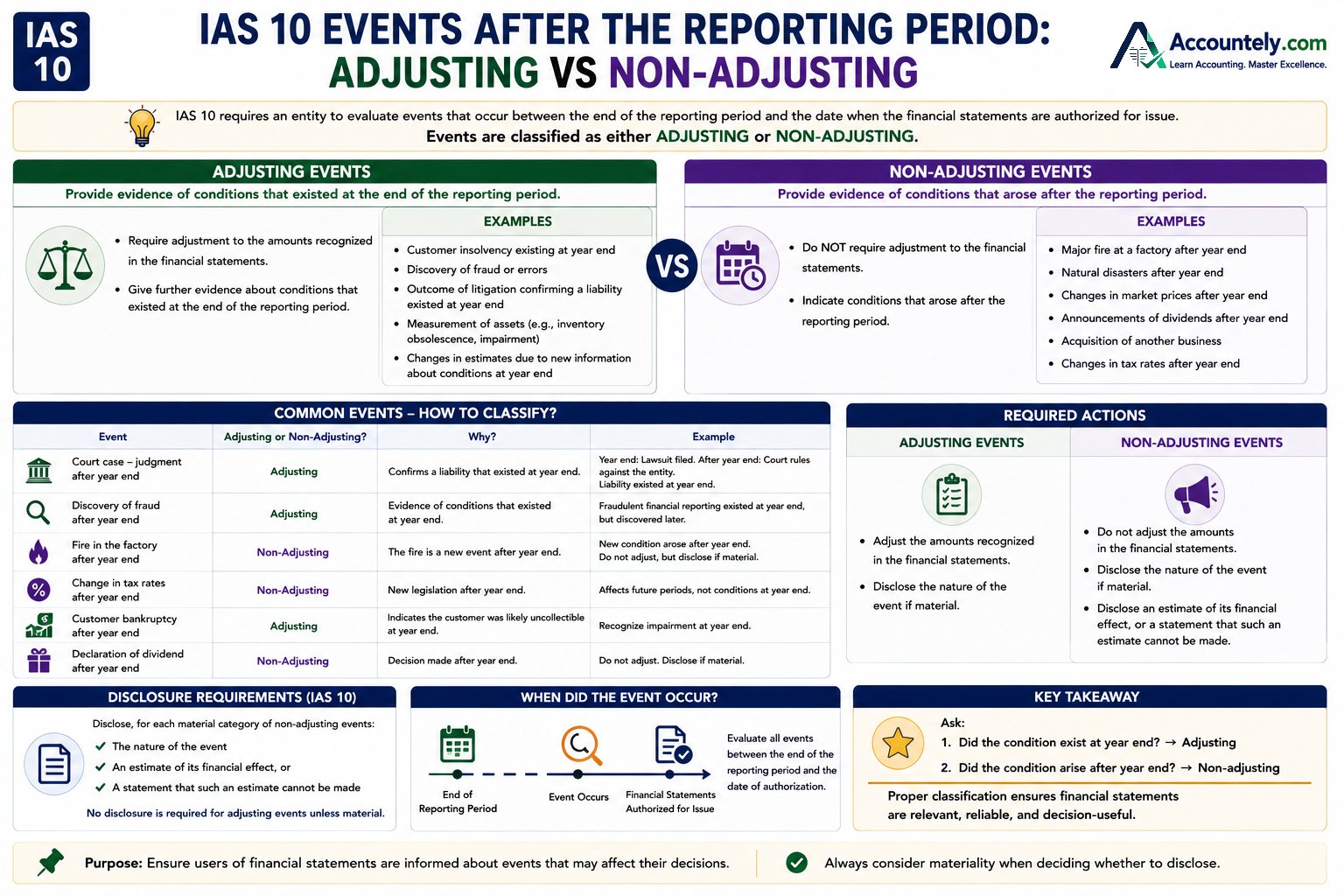
Financial statements are dated 31 December but signed in March. Things happen in between — a customer goes bankrupt, a fire destroys a warehouse, the board declares a dividend. IAS 10 decides which of those events change the numbers and which only get mentioned in the notes. The whole standard reduces to one question: did the event provide evidence of a condition that already existed at the reporting date?
Adjusting vs Non-Adjusting
Adjusting events provide evidence of conditions that existed at the end of the reporting period. The financial statements are adjusted — amounts are changed.
Non-adjusting events are indicative of conditions that arose after the reporting period. The amounts stay as they are; if the event is material, its nature and an estimate of its financial effect are disclosed.
The period covered runs from the reporting date to the date the financial statements are authorised for issue — not the date they are published or approved by shareholders. Events after authorisation are outside IAS 10 entirely.
The Classic Adjusting Events
- A customer goes bankrupt after year end. The bankruptcy usually confirms the receivable was already impaired at the reporting date — the customer's financial distress existed then. Adjust the allowance.
- Inventory sold below cost after year end. This is evidence of the net realisable value at the reporting date. Write the inventory down under IAS 2.
- A court case settled after year end. The settlement confirms that a present obligation existed at the reporting date. Recognise or remeasure the provision under IAS 37 — a contingent liability may become a provision.
- Discovery of fraud or error showing the financial statements were incorrect.
- Determination after year end of the cost of assets purchased, or proceeds from assets sold, before year end.
- Determination of profit-sharing or bonus payments where the entity had a present obligation at the reporting date.
The Classic Non-Adjusting Events
- A fire or flood destroying assets after year end. The assets genuinely existed and were intact at the reporting date — the loss is a new condition. Disclose only.
- A major business combination or disposal of a subsidiary.
- Announcing a plan to discontinue an operation, or a major restructuring.
- A large decline in the market value of investments. The fall reflects circumstances arising after the reporting date, not a misvaluation at it.
- Issuing shares or debentures after year end.
- Abnormally large changes in asset prices or foreign exchange rates.
Worked Example: Two Receivables
A company's year end is 31 December 2026, and the statements are authorised for issue on 15 March 2027.
Event A — On 20 January 2027, a customer owing $80,000 enters liquidation. Investigation shows the customer had been in severe financial difficulty since October 2026.
The condition — the customer's inability to pay — existed at 31 December 2026. This is an adjusting event. Write the receivable down:
Dr Impairment Loss on Receivables — $80,000
Cr Allowance for Expected Credit Losses — $80,000
Event B — On 3 February 2027, a different customer owing $65,000 loses its own major contract unexpectedly and becomes unable to pay. The customer was financially sound at 31 December 2026.
The condition arose after the reporting date. This is a non-adjusting event. The $65,000 receivable stays on the balance sheet at full value; the event is disclosed in the notes with an estimate of its effect.
Identical amounts, identical outcomes, opposite treatments — decided entirely by when the underlying condition arose.
Dividends: Always Non-Adjusting
Dividends declared after the reporting period are not recognised as a liability at the reporting date. At year end there was no present obligation — the entity could still have chosen not to declare them. They are disclosed in the notes instead.
This one catches people out constantly because it feels wrong: the dividend clearly relates to the year just ended. It doesn't matter. Recognition follows the obligation, and the obligation is created by the declaration.
The Going Concern Override
There is one event that is always adjusting, regardless of when the condition arose. If management determines after the reporting period that it intends to liquidate the entity or cease trading, or has no realistic alternative but to do so, the financial statements must not be prepared on a going concern basis. IAS 10 is explicit that this is not merely a disclosure matter — the entire basis of preparation changes.
Where Marks Are Usually Lost
- Accruing a dividend declared after year end. Non-adjusting, always. Disclose it.
- Adjusting for a post-year-end fire. The assets were fine at the reporting date. Disclosure only.
- Using the wrong cut-off date. The window ends at authorisation for issue, not at the AGM or publication.
- Treating a post-year-end market crash as evidence of year-end value. A decline in investment value after the reporting date reflects later conditions.
- Forgetting to disclose non-adjusting events. "Non-adjusting" means the numbers don't move — it does not mean silence. Material non-adjusting events need nature and financial effect disclosed.
- Missing the going concern exception. It overrides the adjusting/non-adjusting analysis entirely.
IAS 10 rewards a single disciplined habit: for every post-year-end event, ask when the condition arose before deciding anything else. Accountely's events after the reporting period challenges mix adjusting and non-adjusting facts in the same question, which is how they appear in a real exam. Since most adjusting events feed straight into a provision or an allowance, IAS 37 provisions and contingent liabilities is the natural companion read.