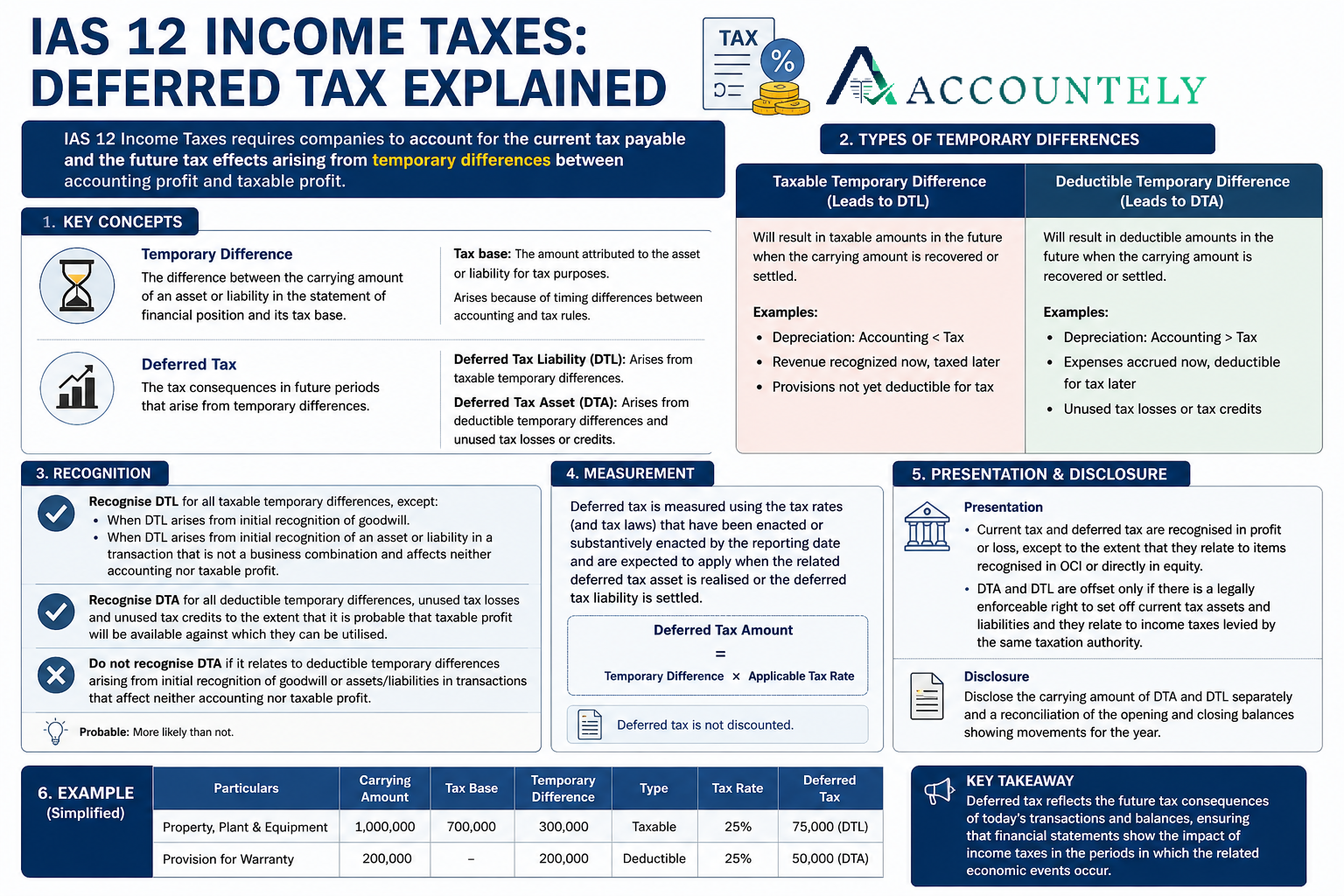
Deferred tax is the topic that separates students who understand the balance sheet from students who have memorised it. IAS 12 doesn't ask what tax the company pays this year — that's current tax, and it's arithmetic. It asks what tax consequences are already locked in by the difference between an asset's accounting value and its tax value. Once you see it as a balance sheet exercise rather than a profit adjustment, it stops being mysterious.
Current Tax vs Deferred Tax
Current tax is the amount payable (or recoverable) on the taxable profit for the period, at the rates enacted or substantively enacted by the reporting date.
Deferred tax is the tax attributable to temporary differences — differences between the carrying amount of an asset or liability in the balance sheet and its tax base. It is the tax you will pay or save in future periods as a result of what has already happened.
Tax Base: The Concept Everything Rests On
The tax base of an asset is the amount that will be deductible for tax purposes against future taxable economic benefits. Broadly: what's left to claim.
The tax base of a liability is its carrying amount, less any amount that will be deductible for tax purposes in future periods.
Get the tax base right and the rest is mechanical. Get it wrong and every subsequent step is wrong.
Taxable vs Deductible Temporary Differences
A taxable temporary difference gives rise to a deferred tax liability. It arises when the carrying amount of an asset exceeds its tax base — you've claimed more tax relief than accounting depreciation, so more tax is payable later.
A deductible temporary difference gives rise to a deferred tax asset. It arises when the carrying amount of an asset is below its tax base, or a liability's carrying amount exceeds its tax base.
The memory hook: carrying amount higher than tax base on an asset = liability. Everything else follows by symmetry.
Worked Example: Accelerated Tax Depreciation
A company buys equipment for $500,000 on 1 January 2026. Accounting depreciation is straight-line over 5 years. Tax depreciation (capital allowances) is 40% in year 1, then reducing. The tax rate is 25%.
At 31 December 2026:
Carrying amount: $500,000 − $100,000 accounting depreciation = $400,000
Tax base: $500,000 − $200,000 capital allowances = $300,000
Taxable temporary difference: $400,000 − $300,000 = $100,000
Deferred tax liability: $100,000 × 25% = $25,000
Journal entry:
Dr Income Tax Expense (deferred) — $25,000
Cr Deferred Tax Liability — $25,000
The company has taken more tax relief than accounting expense, so it has effectively deferred tax into future years. IAS 12 recognises that obligation now.
Crucially, in later years you recompute the closing deferred tax balance and post only the movement. If the required liability at 31 December 2027 is $34,000, the entry is $9,000 — not $34,000.
Worked Example: A Deductible Difference
The same company recognises a warranty provision of $60,000 at year end. Tax relief is only given when the warranty is actually paid.
Carrying amount of the liability: $60,000
Tax base: $60,000 − $60,000 future deduction = $0
Deductible temporary difference: $60,000
Deferred tax asset: $60,000 × 25% = $15,000
Dr Deferred Tax Asset — $15,000
Cr Income Tax Expense (deferred) — $15,000
The Recognition Constraint on Deferred Tax Assets
Deferred tax liabilities are recognised for all taxable temporary differences (subject to narrow exemptions). Deferred tax assets are not symmetrical: they are recognised only to the extent that it is probable that future taxable profit will be available against which the deductible difference can be utilised.
This is a genuine judgement, and it is where auditors spend their time. A loss-making company with $10m of unused tax losses may be able to recognise none of the resulting deferred tax asset, because there is no convincing evidence of future profits to absorb them.
Measurement Rules That Get Overlooked
- Deferred tax is measured at the rates expected to apply when the asset is realised or the liability settled, based on rates enacted or substantively enacted by the reporting date. Not today's rate if a change has already been legislated.
- Deferred tax assets and liabilities are never discounted. IAS 12 prohibits it outright, despite the timing differences often spanning years.
- Deferred tax is always classified as non-current on the balance sheet.
- Deferred tax follows the underlying item: if a gain went to OCI (a revaluation surplus, say), the related deferred tax goes to OCI too — not profit or loss.
Where Marks Are Usually Lost
- Posting the closing balance instead of the movement. The deferred tax charge is the change in the balance, not the balance.
- Discounting the deferred tax balance. Explicitly prohibited.
- Recognising a deferred tax asset with no evidence of future profits. The "probable" test applies to assets only, and it bites.
- Computing the tax base backwards. Write out both the carrying amount and the tax base as separate figures before subtracting — most errors are a reversed subtraction, not a conceptual failure.
- Routing revaluation-related deferred tax through profit or loss. It follows the item into OCI.
- Using the current year's tax rate when a future rate is already enacted.
Deferred tax questions are two calculations stacked — the temporary difference, then the movement — and partial credit lives in showing both. Accountely's income tax challenges mark the temporary difference and the resulting journal separately, so a rate error doesn't wipe out the tax base work. Because deferred tax so often sits on depreciation differences, IAS 16 property, plant and equipment is worth having straight first.