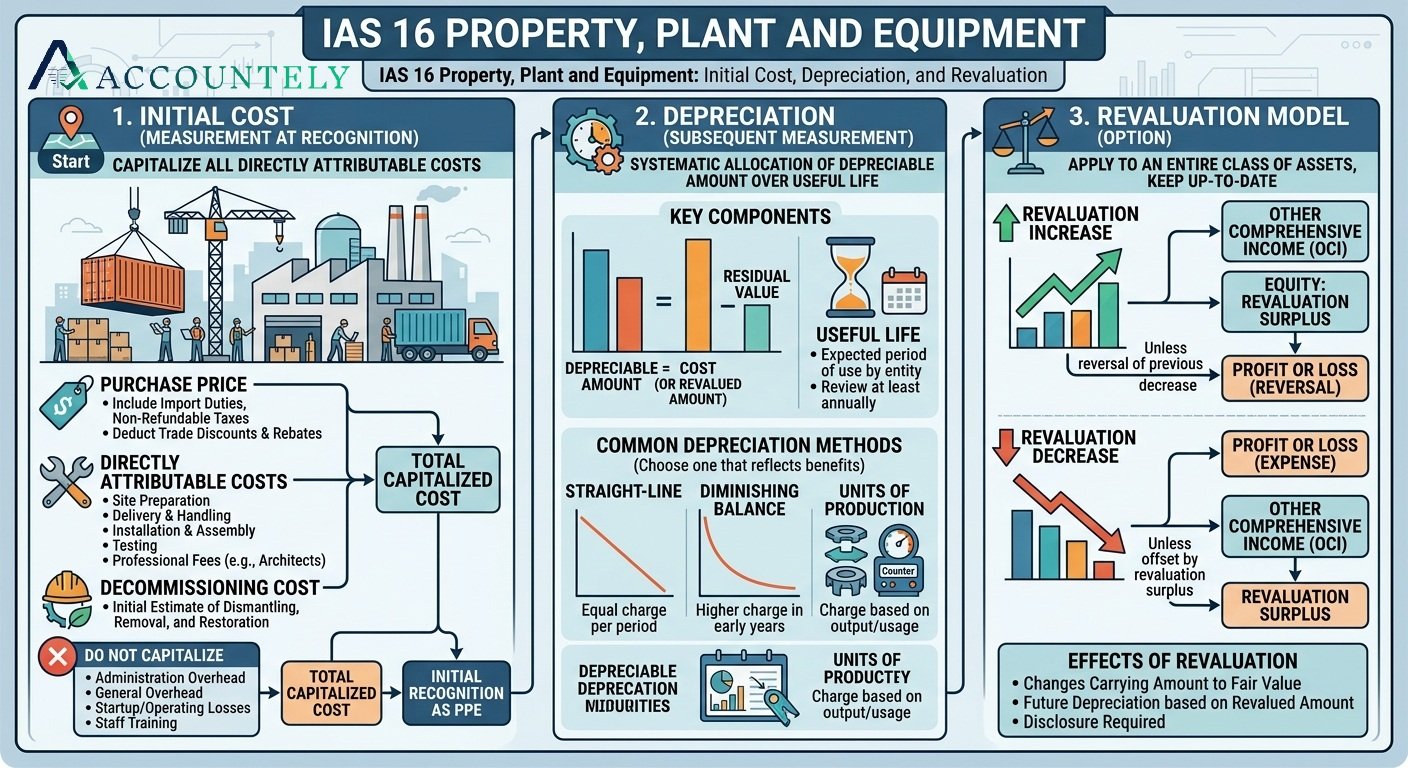
IAS 16 covers property, plant and equipment — tangible assets held for use in production or supply of goods/services, and expected to be used for more than one period. Most of what trips students up isn't the definition, it's two specific questions: what actually belongs in the initial cost, and which of the two measurement models applies afterward.
What Belongs in Initial Cost
The initial cost of an asset under IAS 16 is more than just the invoice price. It includes any cost directly attributable to bringing the asset to the location and condition necessary for it to operate as intended:
Purchase price (less trade discounts)
+ Delivery and handling costs
+ Installation and assembly costs
+ Professional fees (e.g. architects, engineers)
+ Estimated costs of dismantling and removing the asset, if there's a present obligation to do so
= Initial cost
What gets excluded: general administrative overheads, initial operating losses before the asset reaches planned performance, and costs of relocating or reorganising some or all of an entity's operations. These are expensed, not capitalised.
Depreciation and Component Accounting
The depreciable amount — cost minus residual value — is allocated systematically over the asset's useful life. A straight-line example:
Cost: $120,000
Residual value: $20,000
Useful life: 5 years
Annual depreciation: ($120,000 − $20,000) ÷ 5 = $24,000
IAS 16 also requires component depreciation: if an asset has significant parts with materially different useful lives, each part is depreciated separately. An aircraft's engines, for instance, typically wear out on a different schedule than its airframe — each gets its own depreciation calculation rather than one blended rate for the whole asset.
Cost Model vs Revaluation Model
After initial recognition, IAS 16 lets an entity choose between two models, applied consistently to an entire class of assets:
Cost model: carry the asset at cost less accumulated depreciation and any impairment — the same approach used throughout US GAAP, with no upward revaluation permitted.
Revaluation model: carry the asset at fair value at the revaluation date, less subsequent depreciation and impairment, with revaluations performed regularly enough that carrying value doesn't materially differ from fair value. This option doesn't exist under US GAAP at all — it's one of the clearest IFRS/GAAP divergences in the standard.
Worked example: an asset with a carrying value of $80,000 is revalued to a fair value of $95,000.
Revaluation gain: $95,000 − $80,000 = $15,000
Journal entry:
Dr Property, Plant and Equipment — $15,000
Cr Revaluation Surplus (OCI/equity) — $15,000
The gain bypasses profit or loss and goes straight to other comprehensive income — unless it's reversing a downward revaluation of the same asset previously charged to profit or loss, in which case it's recognised in profit or loss to that extent first.
Where Marks Are Usually Lost
- Capitalising costs that should be expensed. Initial operating losses, relocation costs, and general admin overheads never belong in cost, however closely they're tied to getting the asset running.
- Depreciating cost instead of the depreciable amount. Residual value comes out first — leaving it in overstates the depreciation charge every year of the asset's life.
- Blending components with different useful lives into one depreciation rate. When a significant part wears out on a different schedule, it needs its own calculation.
- Running a revaluation gain through profit or loss by default. It goes to other comprehensive income, unless it's specifically reversing a previous downward revaluation of the same asset.
PP&E questions usually fail on one of two things: an item that shouldn't have been capitalised, or a depreciation base that used the wrong number. Accountely's PP&E challenges score each component of the calculation separately, so a wrong final answer doesn't hide which input caused it — much like our depreciation challenges, which isolate the same method-and-base mechanics on their own.