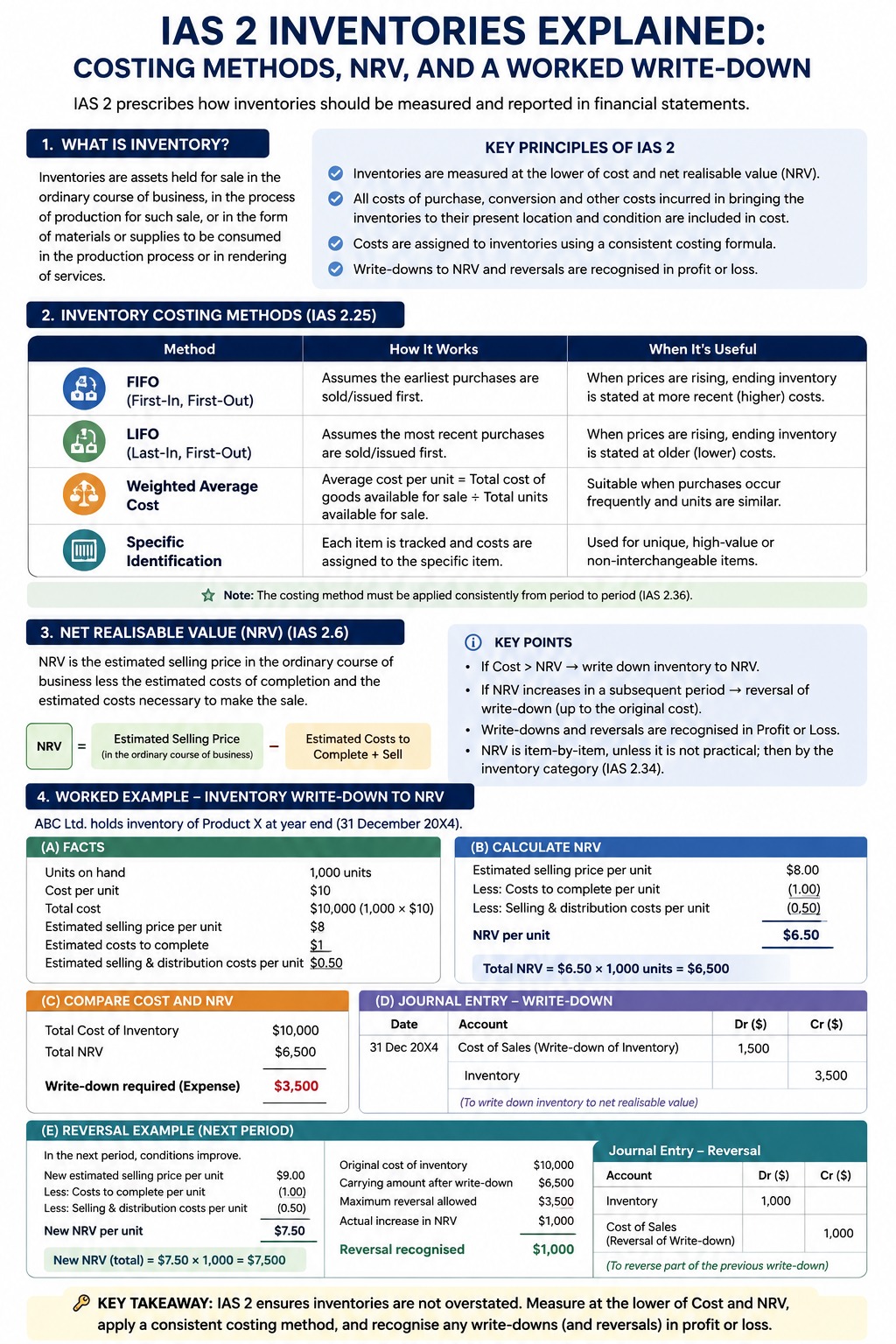
IAS 2 sounds like it should be simple — inventory is just "stuff you haven't sold yet." The standard's actual job is narrower and more specific: it tells you what number to put on that stuff, and when to write it down. Two rules do almost all the work: which cost formulas are allowed, and the lower-of-cost-and-net-realisable-value test.
What Actually Belongs in "Cost"
Cost under IAS 2 is the sum of everything needed to get inventory to its present location and condition, ready for sale: purchase price (less trade discounts and rebates), import duties, and conversion costs like direct labour and a systematic allocation of production overheads.
What does not belong in cost, even though it's tempting to include it: abnormal waste, storage costs (unless storage is a necessary part of the production process itself), general administrative overheads, and selling costs. These are expensed as incurred instead of sitting on the balance sheet inside inventory.
The Cost Formulas IAS 2 Allows
For inventory items that are interchangeable, IAS 2 permits only two cost formulas: FIFO (first-in, first-out) and weighted average cost. Specific identification is required instead, but only for items that aren't ordinarily interchangeable — a car dealership tracking VIN-specific vehicles, for example.
The formula IAS 2 does not allow is LIFO (last-in, first-out) — permitted under US GAAP, but banned under IFRS because it tends to understate inventory value on the balance sheet during periods of rising prices.
The Lower-of-Cost-and-NRV Rule
Inventory is carried at whichever is lower: cost, or net realisable value (NRV). NRV is not fair value — it's specifically:
Estimated selling price
Less: estimated costs to complete
Less: estimated costs necessary to make the sale
= Net realisable value
When NRV falls below cost, inventory is written down and the loss is recognised immediately as an expense (usually within cost of goods sold).
Worked Example: A Write-Down
A company holds inventory carried at cost of $50,000. Due to a drop in market demand, its estimated selling price falls, and after deducting the remaining costs to complete and sell it, NRV works out to $46,000.
Cost: $50,000
Net realisable value: $46,000
Write-down required: $4,000
Journal entry:
Dr Cost of Goods Sold (or Inventory Write-down Expense) — $4,000
Cr Inventory — $4,000
One detail that trips people up: if NRV later recovers, IAS 2 requires the write-down to be reversed — but only up to the original cost, never above it. The reversal is recognised as a reduction in cost of goods sold in the period it occurs, not restated retroactively.
Where Marks Are Usually Lost
- Including selling costs in "cost." Costs to sell reduce net realisable value — they never belong inside the cost figure itself.
- Forgetting the NRV test applies item by item (or group by group), not to inventory as a whole. One product line can need a write-down while another, carried at a profit, offsets nothing — netting them together understates the required write-down.
- Reversing a write-down above original cost. A recovery in NRV is only reversed up to whatever the item was originally carried at, never higher.
- Reaching for LIFO. It's a US GAAP-only cost formula — IAS 2 doesn't permit it under any circumstances.
Inventory questions look straightforward until a write-down or a cost-formula choice changes the numbers halfway through. Accountely's inventory valuation challenges walk through FIFO, weighted average, and NRV write-downs with line-by-line feedback, so you can see exactly which step a wrong answer came from — the same way our journal entry practice problems break down every debit and credit individually.