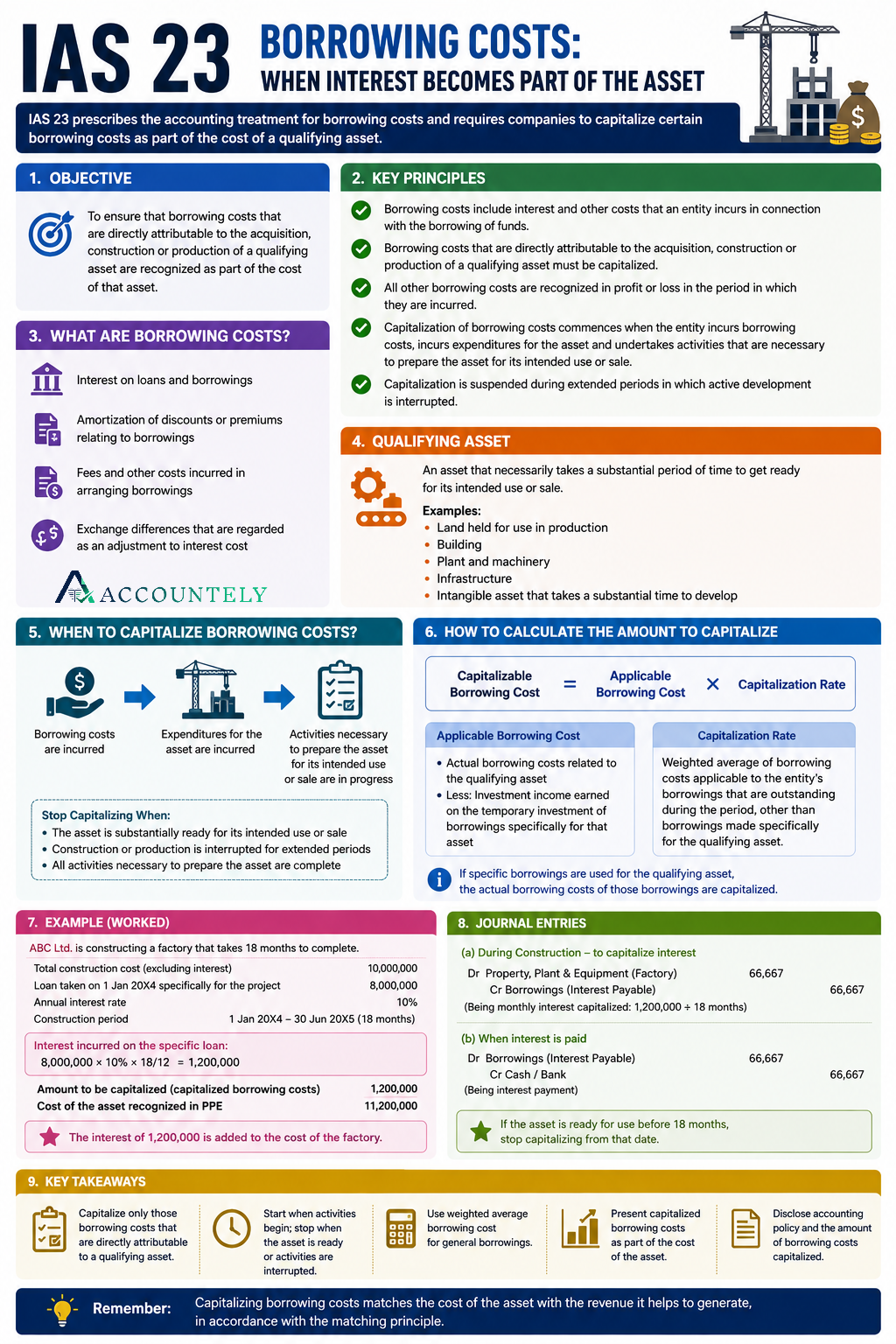
IAS 23 is a short standard with one rule, and it is the rule that stops interest from being a pure expense. When borrowing funds a long construction project, the interest incurred during construction is part of getting that asset ready — so it goes into the asset, not the income statement. The whole standard is about which interest, which asset, and over which window.
The Core Requirement
Borrowing costs directly attributable to the acquisition, construction or production of a qualifying asset form part of the cost of that asset and must be capitalised. All other borrowing costs are recognised as an expense in the period incurred.
Note "must". IAS 23 removed the option to expense — capitalisation for qualifying assets is mandatory under current IFRS.
What Is a Qualifying Asset
A qualifying asset is one that necessarily takes a substantial period of time to get ready for its intended use or sale. Typically: manufacturing plants, power generation facilities, investment properties under construction, and inventories that require a lengthy production process — maturing whisky, aged cheese.
These are not qualifying assets:
- Assets ready for their intended use or sale when acquired — buying a finished building outright
- Inventories routinely manufactured or produced in large quantities on a repetitive basis, even if they take some time
- Financial assets
- Assets measured at fair value, such as biological assets (capitalisation is optional here rather than required)
Specific vs General Borrowings
The calculation differs entirely depending on how the project was funded.
Specific borrowings — funds borrowed specifically to obtain the qualifying asset. Capitalise the actual borrowing costs incurred on that borrowing during the period, less any investment income earned on the temporary investment of those funds. That deduction is mandatory and frequently forgotten.
General borrowings — funds borrowed generally and used in part for the asset. Apply a capitalisation rate — the weighted average of the borrowing costs applicable to the entity's general borrowings outstanding during the period — to the expenditure on the asset. The amount capitalised cannot exceed total borrowing costs incurred in the period.
Worked Example: Specific Borrowing
A company borrows $4,000,000 on 1 January 2026 at 8% specifically to build a factory. Construction runs all year. $1,000,000 of the loan is not needed until April, and is invested for three months at 3%.
Borrowing costs incurred: $4,000,000 × 8% = $320,000
Investment income: $1,000,000 × 3% × 3/12 = $(7,500)
Amount capitalised: $312,500
Journal entry:
Dr Factory Under Construction — $312,500
Dr Interest Expense — $7,500
Cr Cash / Interest Payable — $320,000
Only the net cost of financing the asset lands in the asset. The temporary investment income offsets it, because the entity wasn't truly out of pocket for that portion.
Worked Example: General Borrowings
A company has general borrowings all year of $2,000,000 at 6% and $3,000,000 at 9%. It spends a weighted average of $1,500,000 on a qualifying asset during the year.
Capitalisation rate:
Total interest = ($2,000,000 × 6%) + ($3,000,000 × 9%) = $120,000 + $270,000 = $390,000
Total borrowings = $5,000,000
Rate = $390,000 ÷ $5,000,000 = 7.8%
Amount capitalised = $1,500,000 × 7.8% = $117,000
The remaining $273,000 of interest is expensed. Note the capitalisation rate is a weighted average — using the higher rate, or a simple average of 7.5%, are both wrong.
The Three Timing Rules
Commencement. Capitalisation begins when all three conditions are met: expenditure on the asset is being incurred, borrowing costs are being incurred, and activities necessary to prepare the asset for its intended use or sale are in progress. Borrowing money is not enough on its own — if the loan is drawn in January but site work starts in March, capitalisation starts in March.
Suspension. Capitalisation is suspended during extended periods in which active development is interrupted. The important qualifier is that suspension is not required for temporary delays that are a necessary part of the process — high water levels delaying bridge construction in a region where that is expected, for example, or a period during which substantial technical or administrative work is being carried out.
Cessation. Capitalisation ceases when substantially all the activities necessary to prepare the asset for its intended use or sale are complete — not when the asset is actually brought into use, and not when it is sold. Minor modifications outstanding do not extend the period.
Where Marks Are Usually Lost
- Forgetting to deduct investment income on specific borrowings. The most common single error in IAS 23 computations.
- Starting capitalisation at the drawdown date. All three commencement conditions must hold, including that activities are actually in progress.
- Continuing capitalisation after substantial completion. Cessation is tied to completion of the preparation activities, not occupation or sale.
- Suspending for a normal, expected delay. Only extended interruptions in active development trigger suspension.
- Using a simple rather than weighted average capitalisation rate.
- Capitalising on routinely produced inventory. Repetitively mass-produced items are excluded even where production takes time.
IAS 23 questions reward drawing the timeline before touching the numbers — the window is where the marks are, and the interest arithmetic is easy once its boundaries are fixed. Accountely's borrowing costs challenges test the capitalisation window and the rate calculation separately, so a date error doesn't invalidate correct interest work. Since capitalised interest becomes part of the asset's depreciable cost, IAS 16 property, plant and equipment picks up where this standard leaves off.