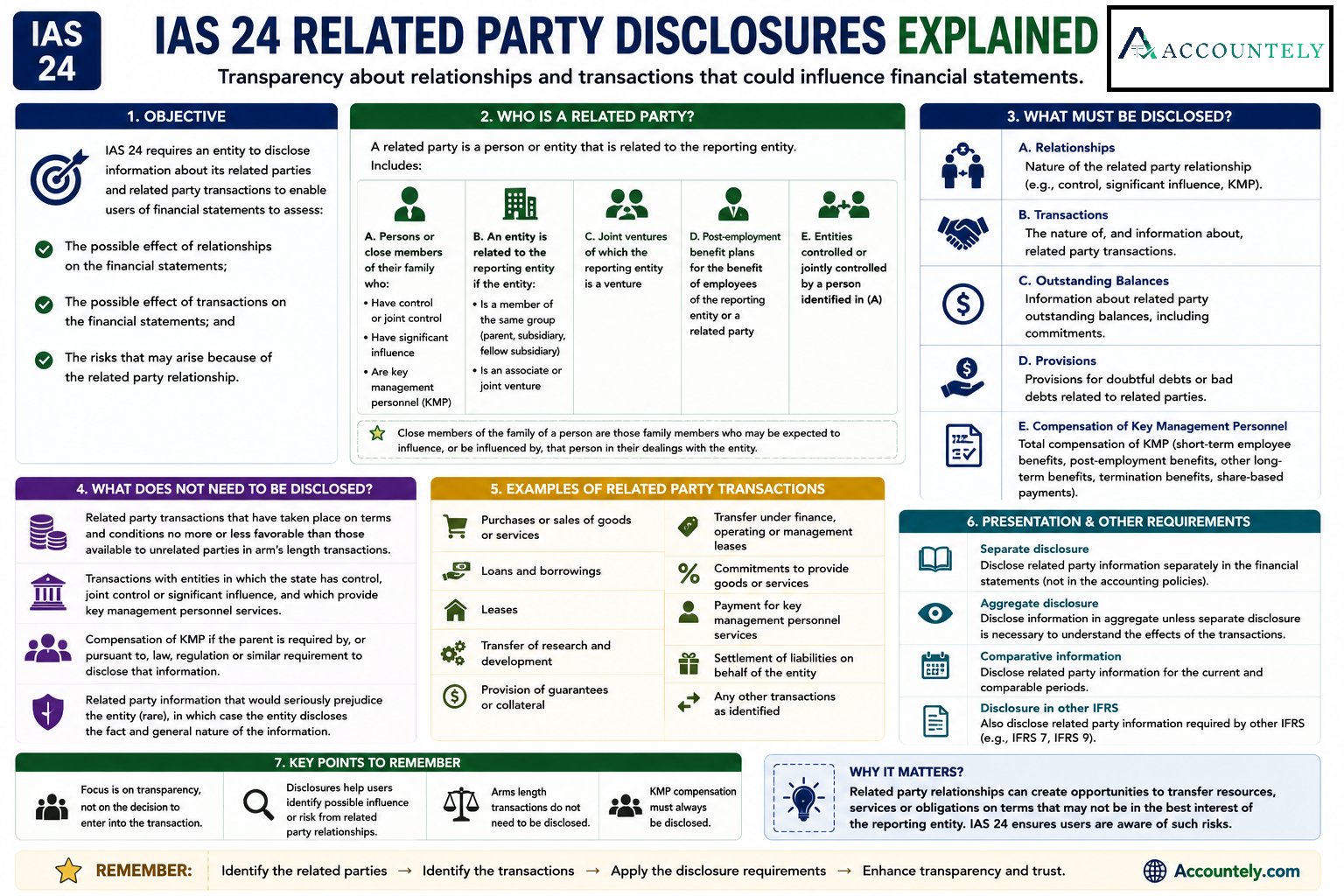
Most accounting standards tell you how to measure something. IAS 24 does not. It contains no recognition rules, no measurement rules, and no guidance on what a number should be. It is a disclosure standard, and that single fact explains most of what students get wrong about it.
Its purpose is narrower and more interesting than it first appears: to make sure a reader knows when the entity's results might have been shaped by dealings with parties who are not at arm's length.
Why the standard exists
Financial statements carry an unstated assumption — that transactions happened on commercial terms between independent parties. Related party transactions break that assumption.
A company might sell inventory to an entity owned by its chief executive at half the market price. It might buy consultancy services from a director's spouse at three times the going rate. It might lend money to its parent interest-free. Every one of those is legal and properly recorded, and every one distorts the picture a reader would otherwise draw.
Crucially, the effect can exist even where no transaction takes place at all. A subsidiary may be profitable only because its parent chooses not to charge for services it provides. IAS 24 therefore requires relationships to be disclosed whether or not anything was actually bought or sold.
IAS 24 changes disclosure, not the numbers
If a company sells goods to a related party at an undervalue, IAS 24 does not require the sale to be restated at market price. The revenue stays at the amount actually charged, measured under the normal standards. What IAS 24 adds is the obligation to tell the reader that the transaction happened, who it was with, and on what terms — so they can form their own judgement.
This trips people up in exams. Asked how a related party sale affects the financial statements, the answer is usually "it does not change the accounting entries at all, but it triggers disclosure." Restating the transaction is the wrong answer.
Who counts as a related party
The definition splits into people and entities. Working through it methodically beats trying to recall a list.
People
A person, or a close member of that person's family, is related to the reporting entity if that person:
- has control or joint control over the entity;
- has significant influence over the entity; or
- is a member of the key management personnel of the entity or of its parent.
Close members of family means those who may be expected to influence, or be influenced by, that person — children, spouse or domestic partner, children of that spouse or partner, and dependants of either.
Entities
An entity is related to the reporting entity if any of the following apply:
- both are members of the same group (so parent, subsidiary and fellow subsidiary are all related to each other);
- one is an associate or joint venture of the other, or of a member of the same group;
- both are joint ventures of the same third party;
- one is a joint venture of a third entity and the other is an associate of that same third entity;
- the entity is a post-employment benefit plan for the benefit of employees of either;
- the entity is controlled or jointly controlled by a person identified above;
- a person with control or joint control has significant influence over the entity, or is a member of its key management personnel;
- the entity, or a member of its group, provides key management personnel services to the reporting entity.
Who is not a related party
The exclusions are tested as often as the inclusions, because they are counter-intuitive. The following are not related parties simply by virtue of the relationship described:
- Two entities that merely share a director or other key management person. A common directorship alone is not enough — there must be control, joint control or significant influence.
- Providers of finance, trade unions, public utilities, and government departments that do not control or jointly control the entity, in the course of their normal dealings.
- A single customer, supplier, franchisor or distributor with whom the entity does a significant volume of business, merely because of the resulting economic dependence.
Your bank is not a related party because you have a large loan with it. Your biggest customer is not a related party because losing them would sink you.
Key management personnel
KMP are those persons having authority and responsibility for planning, directing and controlling the activities of the entity, directly or indirectly. That expressly includes any director, whether executive or non-executive.
Note "indirectly" — the definition is about authority, not job title. Someone who directs the business without an executive title can still be KMP.
Compensation to KMP must be disclosed in total and analysed by category:
- short-term employee benefits
- post-employment benefits
- other long-term benefits
- termination benefits
- share-based payment
Compensation here covers all employee benefits, including those to which IFRS 2 applies, and includes amounts paid on behalf of a parent in respect of the entity.
What must be disclosed
Two obligations, and separating them is the key to answering cleanly.
1. Relationships between a parent and its subsidiaries — always. The name of the parent must be disclosed and, if different, the name of the ultimate controlling party. This applies irrespective of whether any transactions took place. If neither produces publicly available financial statements, the name of the next most senior parent that does must be given.
2. Where transactions have occurred, disclose the nature of the relationship plus enough information to understand the potential effect, including:
- the amount of the transactions;
- the amount of outstanding balances, including commitments — with their terms and conditions, whether they are secured, and the nature of any settlement consideration;
- any guarantees given or received;
- provisions for doubtful debts on those outstanding balances;
- the expense recognised in the period for bad or doubtful debts due from related parties.
These must be disclosed separately for each category of related party — parent, subsidiaries, associates, joint ventures, KMP, and other related parties — not merged into a single total.
A "related party transaction" is a transfer of resources, services or obligations, regardless of whether a price is charged. A free-of-charge transfer is still a transaction for this purpose, which is precisely why interest-free intragroup loans and unrecharged head-office services fall inside the standard.
The government-related entity exemption
Applied literally, the definition would bury a state-owned entity in disclosure: every other entity controlled by the same government would be a related party. In a country with extensive state ownership, that list is unusable.
IAS 24 therefore grants a partial exemption. An entity that is government-related is relieved from the full disclosure requirements in respect of transactions with that government and with other entities related through it. Instead it discloses the name of the government and the nature of the relationship, together with the nature and amount of each individually significant transaction, and a qualitative or quantitative indication of the extent of collectively significant ones.
It is a reduction in detail, not a removal of the obligation.
A worked scenario
Meridian Ltd is a wholly owned subsidiary of Kestrel Holdings. During the year:
- Meridian sold goods worth $400,000 to Harlow Trading, a company owned by Meridian's finance director. $90,000 was still outstanding at year end, unsecured and interest-free.
- Kestrel provided management services to Meridian and charged nothing.
- Meridian paid its directors $650,000 in salaries and $70,000 in pension contributions.
- Meridian bought $2.1m of raw materials from Ashfield Supplies, its largest supplier, accounting for 60% of Ashfield's revenue.
Disclose: the parent relationship with Kestrel and the ultimate controlling party, regardless of any transactions. The Harlow sales — the finance director is KMP, so a company they own is a related party — including the $400,000, the $90,000 balance, and the fact it is unsecured and interest-free. The management services from Kestrel, even though nothing was charged, because a free transfer of services is still a related party transaction. KMP compensation of $720,000, split $650,000 short-term and $70,000 post-employment.
Do not disclose the Ashfield purchases. Economic dependence, even at 60% of the supplier's revenue, does not make it a related party.
Where marks are usually lost
- Restating a related party transaction to market value. IAS 24 is disclosure-only; the amount recorded does not change.
- Omitting the parent relationship when there were no transactions. It is required either way.
- Ignoring transactions with no price. Free services and interest-free loans are transactions for this standard.
- Treating a shared director as sufficient. It is not, without control or significant influence.
- Treating a dominant customer or supplier as related. Economic dependence is explicitly excluded.
- Giving one combined KMP figure. The analysis by the five categories is part of the requirement.
- Claiming an arm's-length basis without support. A statement that transactions were at arm's length may only be made if that can be substantiated.
Practise it
Related party questions are usually written as a scenario with several transactions, only some of which qualify — the marks are in classifying correctly and then stating the disclosure precisely, not in arithmetic. Work through the definition in order each time: is this a person or an entity, and which specific limb of the test does it meet?
If group relationships are still unclear, our guide to preparing a balance sheet covers how ownership interests are presented, and stockholders' equity challenges drill the structures these relationships sit on. You can practise the full set on Accountely's accounting challenges, with every line scored and explained.