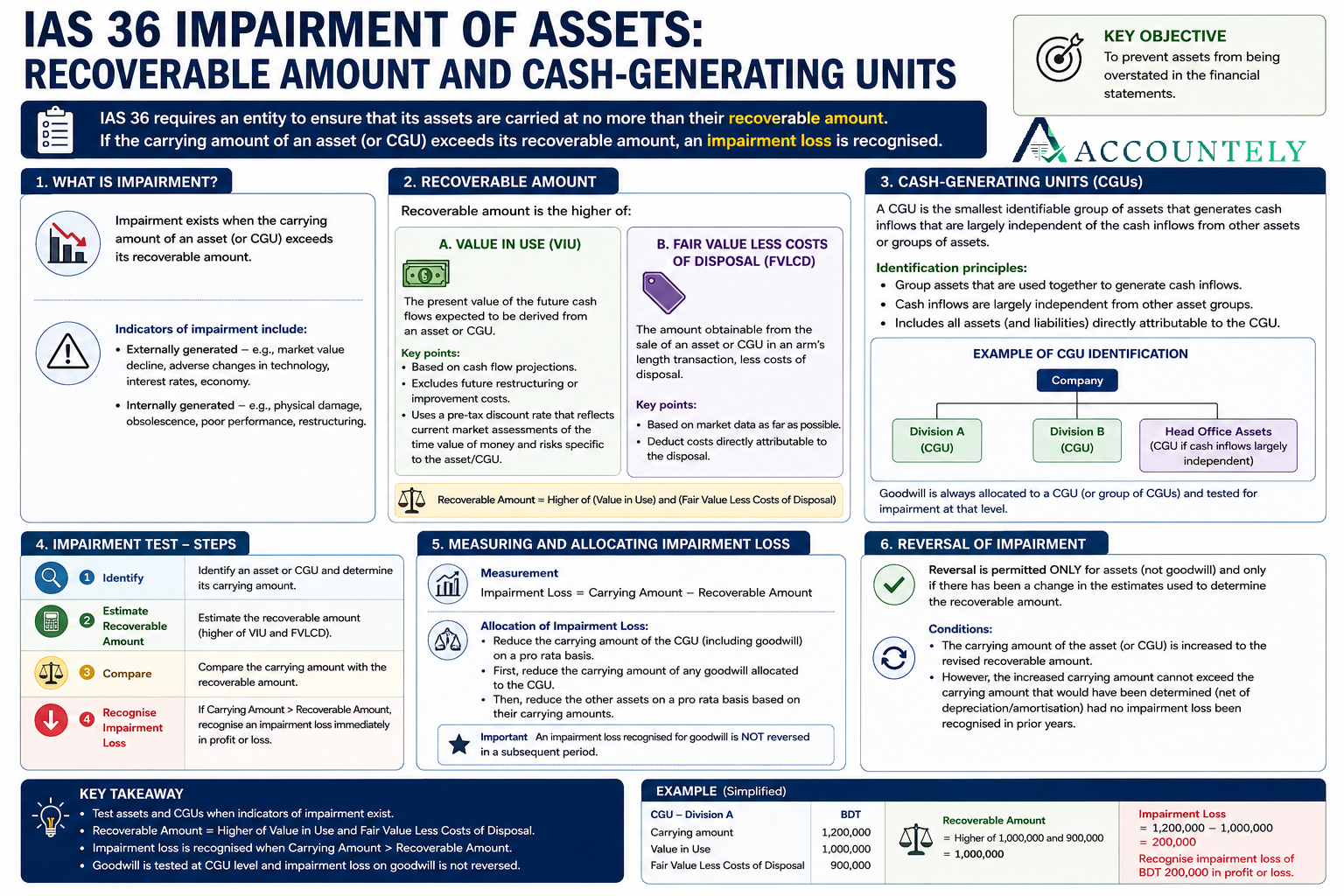
Depreciation spreads an asset's cost over its life on a schedule decided years ago. IAS 36 exists for the moment reality diverges from that schedule — when an asset is genuinely worth less than the books say. The standard's job is to stop assets being carried above what the business can actually recover from them, and its core is a single comparison you can do in one line once you know the two numbers.
The Core Rule
An asset is impaired when its carrying amount exceeds its recoverable amount. The impairment loss is the difference, and it is recognised immediately.
Recoverable amount is the higher of:
1. Fair value less costs of disposal — what you'd net from selling it
2. Value in use — the present value of the future cash flows expected from continuing to use it
Higher, not lower. The logic is that a rational entity will choose whichever course leaves it better off, so the asset is worth at least the better of the two options. This is the single most commonly inverted rule in the standard.
When to Test
An entity assesses at each reporting date whether there is any indication of impairment. Indicators include a significant decline in market value, adverse changes in technology, markets or the legal environment, increases in market interest rates, the carrying amount of net assets exceeding market capitalisation, evidence of physical damage or obsolescence, and worse-than-expected economic performance.
Three assets are tested annually regardless of indicators:
- Goodwill acquired in a business combination
- Intangible assets with an indefinite useful life
- Intangible assets not yet available for use
The common thread is that none of these are being systematically amortised, so nothing else would ever catch a decline in value.
Worked Example: A Single Asset
A machine has a carrying amount of $450,000. Following a technological shift, the company tests it for impairment:
- Fair value less costs of disposal: $360,000
- Value in use (PV of expected cash flows): $395,000
Recoverable amount = higher of the two = $395,000
Impairment loss = $450,000 − $395,000 = $55,000
Journal entry:
Dr Impairment Loss — $55,000
Cr Accumulated Impairment — Machinery — $55,000
Note what happens if you take the lower figure by mistake: you'd write down to $360,000 and book a $90,000 loss — a $35,000 overstatement. After impairment, depreciation is recalculated on the new $395,000 carrying amount over the remaining useful life.
Cash-Generating Units
Value in use often can't be determined for a single asset, because the asset doesn't generate cash flows on its own — a factory's conveyor belt has no independent revenue. In that case the asset is tested as part of its cash-generating unit (CGU): the smallest identifiable group of assets generating cash inflows largely independent of those from other assets.
When a CGU is impaired, IAS 36 sets a strict allocation order:
1. First, reduce the carrying amount of any goodwill allocated to the CGU
2. Then, allocate the remainder to the other assets pro rata on their carrying amounts
There is a floor on step 2: an individual asset is not reduced below the highest of its own fair value less costs of disposal, its value in use, and zero. Any amount that can't be allocated because of that floor is reallocated pro rata to the other assets.
Worked Example: A CGU
A CGU has a carrying amount of $1,000,000, comprising goodwill $150,000, buildings $500,000 and equipment $350,000. Recoverable amount is assessed at $820,000.
Impairment loss = $1,000,000 − $820,000 = $180,000
Allocation:
Goodwill — write off in full: $(150,000), leaving $0
Remaining loss: $180,000 − $150,000 = $30,000
Buildings: $30,000 × (500 ÷ 850) = $(17,647)
Equipment: $30,000 × (350 ÷ 850) = $(12,353)
Note the pro rata base excludes goodwill, because goodwill has already absorbed its share.
Reversals: Allowed, Except for Goodwill
If an impairment loss later reverses, IAS 36 permits the reversal — but the increased carrying amount must not exceed the carrying amount that would have been determined (net of depreciation) had no impairment loss been recognised. You can undo the impairment; you cannot use a reversal to write the asset up above its original trajectory.
The exception is absolute: an impairment loss on goodwill is never reversed. Once written off, it stays off. Any subsequent recovery is treated as internally generated goodwill, which IFRS does not permit recognising.
This is a real IFRS/US GAAP divergence — US GAAP prohibits reversal of impairment losses on assets held for use generally, not just goodwill.
Where Marks Are Usually Lost
- Taking the lower of fair value less costs of disposal and value in use. Recoverable amount is the higher. This costs more marks than any other single error in the standard.
- Reversing a goodwill impairment. Never permitted, under any circumstances.
- Allocating a CGU loss pro rata across everything including goodwill. Goodwill goes first and in full, then pro rata on the rest.
- Forgetting to reset depreciation after impairment. The revised carrying amount is depreciated over the remaining life — the old charge no longer applies.
- Reversing above the "would have been" carrying amount. The cap is the depreciated original cost, not the original cost.
- Not testing goodwill because there was no indicator. Goodwill, indefinite-life intangibles and assets not yet in use are tested annually regardless.
Impairment questions almost always hinge on one of two decisions — which recoverable amount to take, and how to allocate across a CGU — with the arithmetic being straightforward once those land. Accountely's impairment challenges score the recoverable amount decision separately from the allocation, so you can tell which half you're actually losing. If indefinite-life intangibles are what triggered the test, IAS 38 intangible assets covers why they're never amortised in the first place.