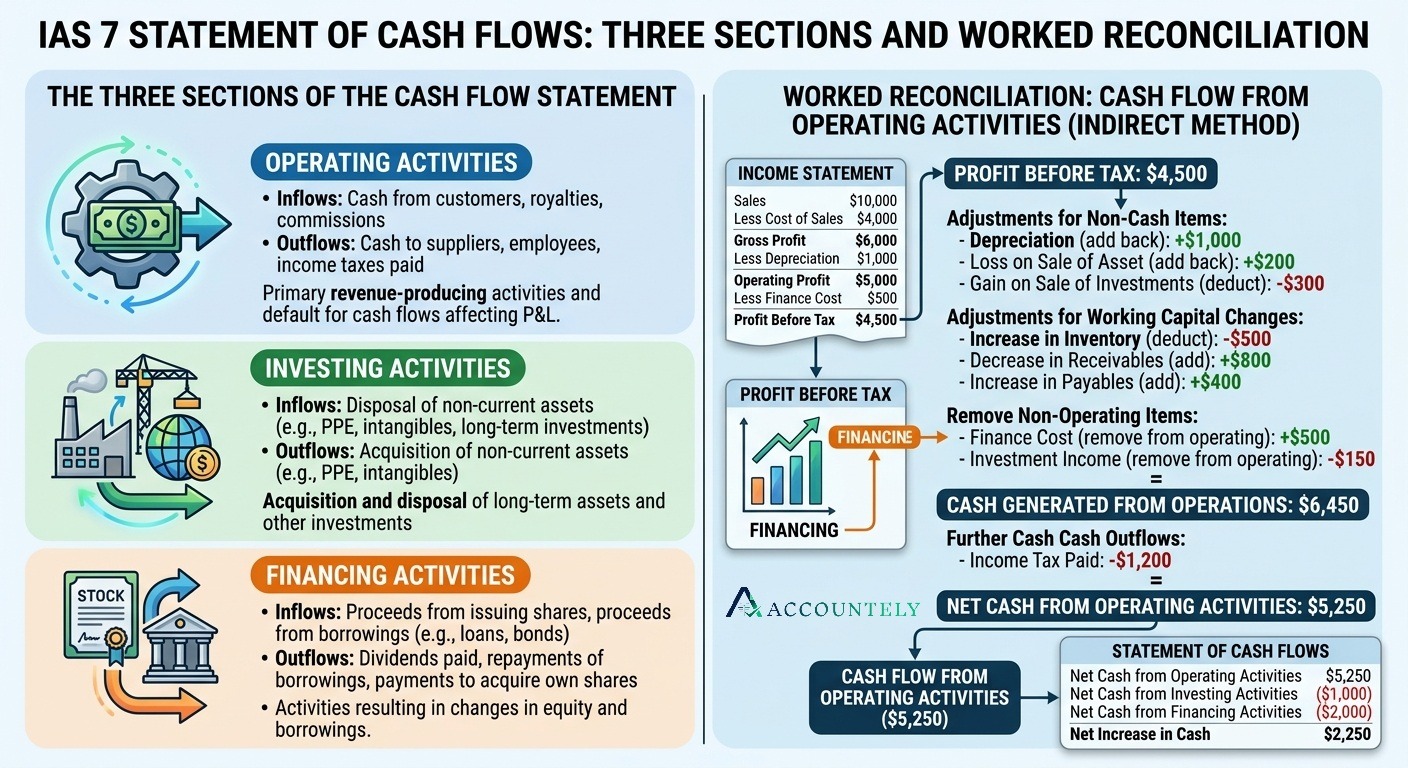
IAS 7 is the standard behind the one statement students reliably dread. The difficulty isn't conceptual — cash in, cash out — it's that the statement of cash flows is the only primary statement you build by undoing accrual accounting rather than applying it. This is what IAS 7 actually requires, how the three sections work, and where the indirect method reconciliation goes wrong.
Three Sections, and Why the Split Matters
IAS 7 requires cash flows to be classified into three activities:
Operating — the principal revenue-producing activities, plus anything that isn't investing or financing. This is the residual category and the one analysts care most about, because it shows whether the business funds itself.
Investing — acquisition and disposal of long-term assets and other investments not included in cash equivalents. Buying equipment, selling a subsidiary, lending money to another party.
Financing — changes in the size and composition of contributed equity and borrowings. Issuing shares, drawing and repaying loans, paying dividends.
The split matters because the same total change in cash tells a completely different story depending on where it came from. A company generating $2m from operations is healthy; one generating $2m by selling its factory and borrowing is not, and both show the same bottom line.
Cash and Cash Equivalents: What Counts
Cash equivalents are short-term, highly liquid investments readily convertible to known amounts of cash and subject to an insignificant risk of changes in value. In practice this means an original maturity of three months or less from the date of acquisition — not three months from the reporting date.
A twelve-month term deposit bought nine months ago is not a cash equivalent, even though it matures in three months' time. Equity investments are generally excluded outright, because their value moves. Bank overdrafts repayable on demand that form an integral part of cash management are included as a component of cash and cash equivalents, netted rather than shown as financing.
Operating Cash Flows: Direct or Indirect
IAS 7 permits two presentations of operating cash flows and encourages the direct method, while nearly every real company uses the indirect one.
Direct method — discloses major classes of gross cash receipts and payments: cash received from customers, cash paid to suppliers, cash paid to employees.
Indirect method — starts with profit before tax and adjusts for non-cash items, items classified elsewhere, and working capital movements.
Worked Example: The Indirect Method Reconciliation
A company reports profit before tax of $340,000. During the year:
- Depreciation charged: $85,000
- Loss on disposal of equipment: $12,000
- Interest expense: $20,000 (interest paid $18,000)
- Inventory increased from $110,000 to $145,000
- Trade receivables decreased from $200,000 to $172,000
- Trade payables increased from $95,000 to $118,000
- Income tax paid: $70,000
The reconciliation:
Profit before tax — $340,000
Add depreciation — $85,000
Add loss on disposal — $12,000
Add back interest expense — $20,000
Operating profit before working capital changes — $457,000
Increase in inventory — $(35,000)
Decrease in receivables — $28,000
Increase in payables — $23,000
Cash generated from operations — $473,000
Interest paid — $(18,000)
Income taxes paid — $(70,000)
Net cash from operating activities — $385,000
Three things are doing the real work here. Depreciation and the disposal loss are added back because they reduced profit without moving cash. Interest expense is added back and interest paid subtracted separately, because the accrual and the cash amount differ. And the working capital movements follow one rule: an increase in an asset consumes cash, an increase in a liability provides it.
Interest, Dividends and Tax: Where They Can Sit
IAS 7 gives a policy choice, applied consistently period to period:
- Interest paid — operating or financing
- Interest received — operating or investing
- Dividends received — operating or investing
- Dividends paid — operating or financing
Taxes on income are classified as operating unless they can be specifically identified with financing or investing activities. Note this is one of the clearer IFRS/US GAAP differences: US GAAP fixes interest paid and received, and dividends received, in operating, allowing far less choice.
Non-Cash Transactions Are Excluded — and Disclosed
Investing and financing transactions that don't require cash are excluded from the statement itself but disclosed elsewhere in the financial statements. Acquiring an asset under a lease, converting debt to equity, and issuing shares to acquire a subsidiary all belong here. They change the balance sheet materially while never touching the cash line, and leaving them entirely undisclosed would hide real financing activity.
Where Marks Are Usually Lost
- Getting the working capital sign backwards. Inventory going up is a cash outflow. Receivables going down is a cash inflow — the company collected. Say the direction out loud before writing the sign.
- Adding back a gain on disposal instead of subtracting it. Losses are added back, gains are deducted, and the full sale proceeds then appear under investing. Otherwise the gain is counted twice.
- Using the interest expense figure as interest paid. They differ whenever there is accrued interest at either year end.
- Treating a three-month-from-year-end deposit as a cash equivalent. The three months runs from acquisition.
- Netting proceeds and purchases of PP&E. Investing cash flows are reported gross unless IAS 7 specifically permits netting.
- Putting a lease-acquired asset in investing. No cash moved at inception — it's a non-cash transaction requiring disclosure.
Cash flow questions punish process errors more than knowledge gaps, which is exactly why doing them repeatedly beats re-reading the standard. Accountely's indirect method challenges and direct method challenges mark each adjustment line separately, so a sign error on inventory doesn't hide whether the rest of your reconciliation was sound. For the choice between the two presentations, see direct vs indirect method compared.