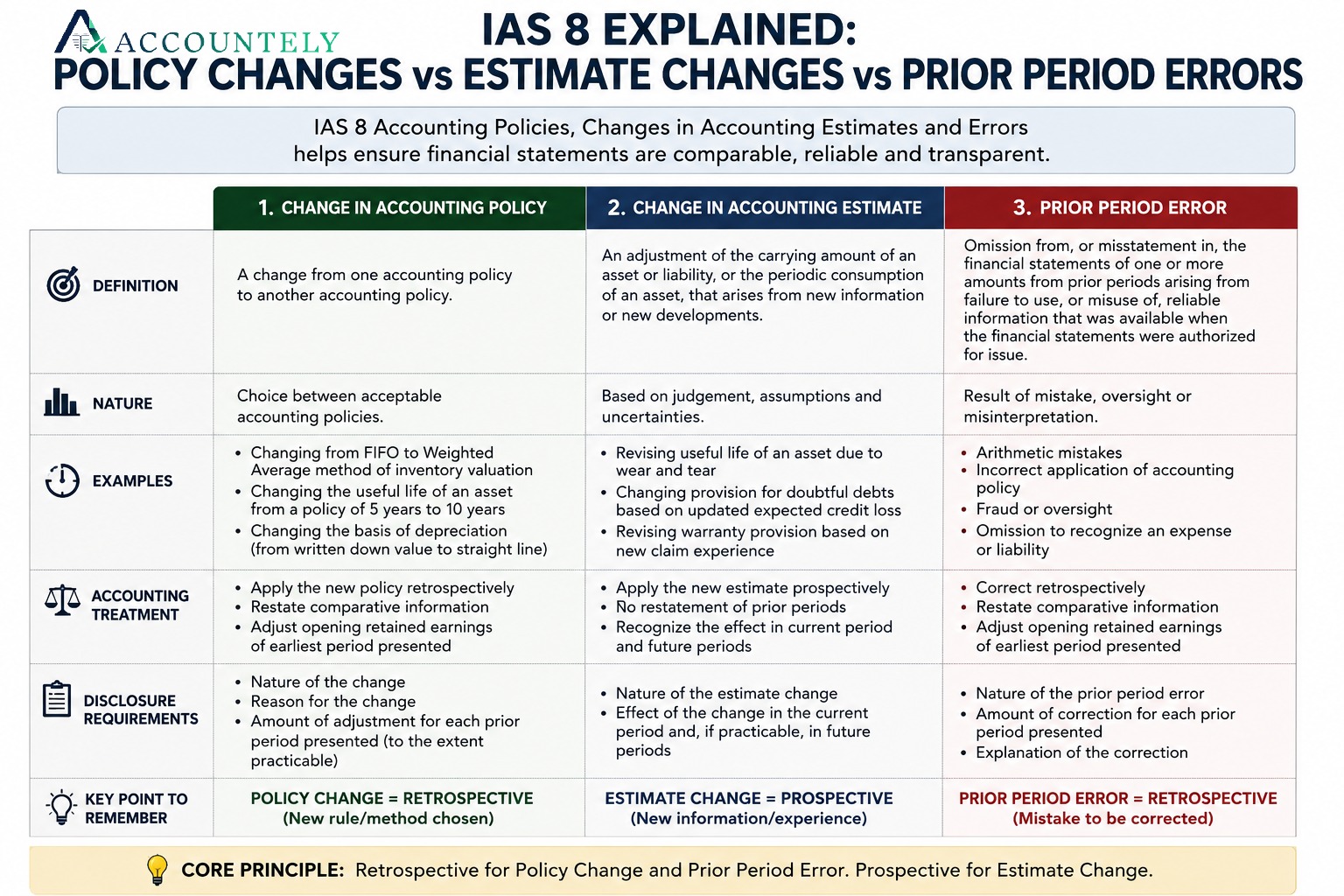
IAS 8 governs three things that look similar and are treated completely differently: changing an accounting policy, changing an accounting estimate, and correcting an error. Two of those are applied retrospectively and one is not. Identifying which of the three you are looking at is the entire question — once classified, the accounting follows mechanically.
The Three Categories
Change in accounting policy — a change in the specific principles, bases, conventions, rules and practices applied in preparing financial statements. Switching inventory costing from FIFO to weighted average. Moving from the cost model to the revaluation model is technically a policy change too, though IAS 16 gives it its own prospective treatment.
Change in accounting estimate — an adjustment to the carrying amount of an asset or liability resulting from new information or new developments. Revising the useful life of a machine, changing the allowance for expected credit losses, revising a warranty provision rate.
Prior period error — an omission from, or misstatement in, the financial statements for one or more prior periods arising from a failure to use, or misuse of, reliable information that was available and could reasonably be expected to have been obtained. The key word is available: if the information existed and should have been used, it's an error, not an estimate revision.
The Treatment Table
Policy change — retrospective. Restate comparatives and adjust the opening balance of retained earnings for the earliest period presented, as if the new policy had always been applied.
Estimate change — prospective. Recognise the effect in the current period, and future periods if affected. No restatement, no touching retained earnings.
Error correction — retrospective restatement. Restate comparatives and adjust opening retained earnings, as if the error had never occurred.
Notice that policy changes and error corrections land in the same place operationally. The distinction still matters for disclosure — one is a legitimate improvement, the other an admission of a mistake — but the mechanics are the same.
Worked Example: An Estimate Change
A machine cost $600,000 on 1 January 2023, with an estimated useful life of 10 years and no residual value. Straight-line depreciation is $60,000 a year. On 1 January 2026, after three years, management revises the remaining useful life to 4 years.
Carrying amount at 1 January 2026:
Cost — $600,000
Accumulated depreciation (3 × $60,000) — $(180,000)
Carrying amount — $420,000
The revised charge spreads the current carrying amount over the remaining revised life:
$420,000 ÷ 4 years = $105,000 per year
Journal entry each year from 2026:
Dr Depreciation Expense — $105,000
Cr Accumulated Depreciation — $105,000
Nothing is restated. The three years already charged at $60,000 stand — they were the best estimate at the time, based on the information then available. This is the single most common IAS 8 exam scenario, and the wrong answer is always the one that goes back and recalculates the earlier years.
Worked Example: An Error
Same company discovers in 2026 that a $50,000 repair invoice from 2025 was capitalised as part of the machine instead of expensed. Depreciation of $5,000 was charged on it in 2025.
This is a prior period error — the invoice was available and was misclassified. The 2025 comparatives are restated: profit for 2025 falls by the net $45,000 ($50,000 expense less $5,000 depreciation reversed), and the opening balance of retained earnings for 2026 is adjusted accordingly.
Note the contrast with the depreciation example. Both change reported profit. One touches only the future, the other reaches back and rewrites what was already published — entirely because of whether the information was available at the time.
When You Can't Tell Which It Is
IAS 8 anticipates this: when it is difficult to distinguish a change in policy from a change in estimate, the change is treated as a change in estimate. The prospective treatment is the default, because retrospective restatement is the more disruptive of the two and shouldn't happen on an ambiguous call.
Choosing a Policy When No Standard Applies
Where no IFRS specifically applies to a transaction, management uses judgement to develop a policy that is relevant and reliable. IAS 8 sets a hierarchy: first look to the requirements in IFRSs dealing with similar and related issues, then the definitions and recognition criteria in the Conceptual Framework. Management may then consider pronouncements of other standard-setting bodies using a similar conceptual framework, and accepted industry practice — but only where these don't conflict with the sources above.
Where Marks Are Usually Lost
- Restating prior years for a useful life revision. This is the headline trap. Estimate changes are prospective, always.
- Spreading the revised depreciation over the original cost. Use the carrying amount at the date of change, not the original cost, and the remaining life, not the total revised life.
- Calling a misclassification an estimate change. If the correct information was available at the time, it's an error and the comparatives get restated.
- Forgetting the opening retained earnings adjustment. Retrospective treatment isn't just restating last year's income statement — the earliest presented period's opening equity moves too.
- Changing policy without justification. A voluntary policy change is only permitted if it results in reliable and more relevant information. "Because the new method gives a better profit" is not that.
IAS 8 questions are classification questions wearing a computation costume — the arithmetic is trivial once you've decided which of the three boxes you're in. Accountely's accounting changes challenges and accounting error challenges test the classification decision and the restatement separately, so you can see which half went wrong. If the depreciation mechanics themselves are the sticking point, start with the straight-line method explained.