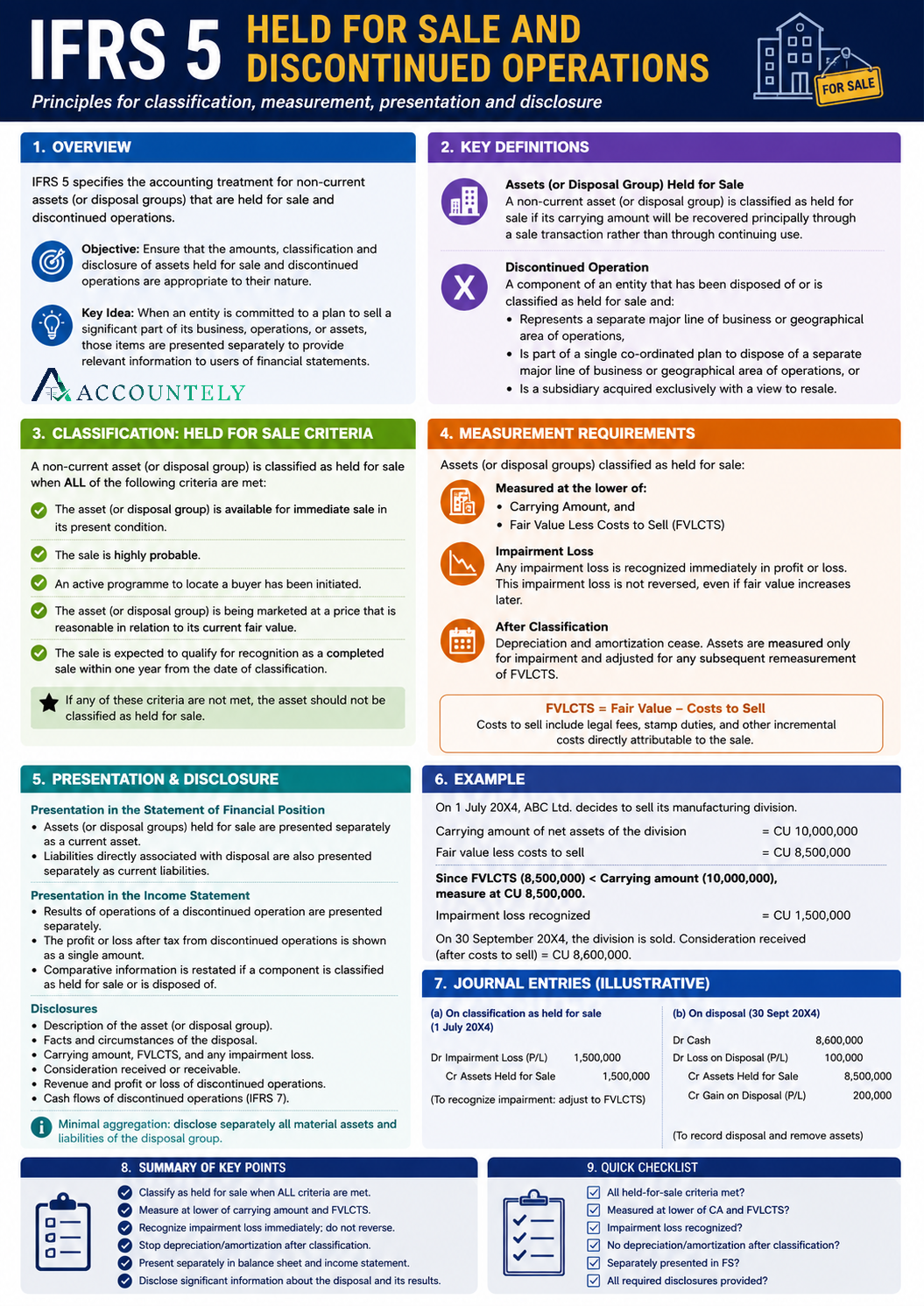
IFRS 5 covers the moment a business decides to get rid of something substantial. It does two distinct jobs that students routinely merge: it changes how an asset is measured and presented once it is held for sale, and it changes how a whole component's results are reported once it qualifies as a discontinued operation. An asset can be held for sale without being a discontinued operation, so the two tests are applied separately.
The Held for Sale Criteria
A non-current asset (or disposal group) is classified as held for sale when its carrying amount will be recovered principally through a sale transaction rather than through continuing use. Two conditions must both be met:
1. The asset is available for immediate sale in its present condition, subject only to terms usual and customary for such sales
2. The sale is highly probable
"Highly probable" is not a vague standard — IFRS 5 spells out what it requires:
- Management at the appropriate level is committed to a plan to sell
- An active programme to locate a buyer has been initiated
- The asset is being actively marketed at a price reasonable in relation to its current fair value
- The sale is expected to qualify as a completed sale within one year of classification
- Actions required indicate it is unlikely the plan will be significantly changed or withdrawn
An intention to sell is not enough. A board resolution with no marketing activity is not enough. A property listed at double its market value is not being actively marketed at a reasonable price, and so fails the test.
Measurement Once Classified
A non-current asset held for sale is measured at the lower of its carrying amount and fair value less costs to sell. Any write-down is recognised as an impairment loss.
The rule that catches everyone: depreciation ceases from the date of classification. The asset is no longer being consumed through use — it is being held for sale — so charging depreciation would double-count against the fair value measurement. Depreciation stops even if the sale later takes eighteen months.
Note this is "lower of", the opposite direction from IAS 36's recoverable amount, which is the higher of two figures. The two standards pull different ways, and mixing them up is a common error.
Presentation on the Balance Sheet
Assets classified as held for sale are presented separately from other assets on the face of the balance sheet, and liabilities of a disposal group separately from other liabilities. They are not offset against each other.
Prior period balance sheets are not restated to reflect the new classification. This is a deliberate asymmetry with the income statement treatment below.
Worked Example
A company classifies a division as held for sale on 1 September 2026. At that date the division's assets have a carrying amount of $3,200,000. Fair value is assessed at $3,050,000, with costs to sell of $80,000. Annual depreciation on the division's assets had been $240,000.
Fair value less costs to sell = $3,050,000 − $80,000 = $2,970,000
Lower of $3,200,000 and $2,970,000 = $2,970,000
Impairment loss = $230,000
Dr Impairment Loss — $230,000
Cr Assets Held for Sale — $230,000
Depreciation is charged for January to August only — eight months at $20,000 = $160,000 — and nothing from 1 September. The full-year $240,000 is the wrong answer.
Discontinued Operations: A Separate Test
A discontinued operation is a component of an entity that has either been disposed of or is classified as held for sale, and:
- Represents a separate major line of business or geographical area of operations, or
- Is part of a single co-ordinated plan to dispose of such a line or area, or
- Is a subsidiary acquired exclusively with a view to resale
The bar is "separate major line of business or geographical area". Selling one machine, one shop, or a small product line does not qualify — that asset may be held for sale without any discontinued operation presentation.
Presentation of a Discontinued Operation
A single amount is presented on the face of the statement of profit or loss, comprising the post-tax profit or loss of the discontinued operation plus the post-tax gain or loss on measurement to fair value less costs to sell or on disposal. The analysis of that single figure into revenue, expenses and tax is given in the notes.
Critically, comparative income statement figures are restated so that the prior period shows the discontinued operation on the same basis. This is the opposite of the balance sheet treatment, and the reason is the purpose of the split: the whole point is to let a reader see continuing operations on a like-for-like basis across periods.
Where Marks Are Usually Lost
- Continuing to depreciate an asset held for sale. Depreciation stops at classification, full stop.
- Using the higher of carrying amount and fair value less costs to sell. IFRS 5 takes the lower — don't import the IAS 36 rule.
- Restating the comparative balance sheet. Only the income statement comparatives are restated.
- Failing to restate the comparative income statement. The mirror-image error, and equally costly.
- Calling any held-for-sale asset a discontinued operation. It needs to be a separate major line of business or geographical area.
- Offsetting held-for-sale assets against the disposal group's liabilities. Both are presented separately, gross.
- Classifying an asset the entity intends to abandon. Abandonment is not sale — held-for-sale classification does not apply, though it may still be a discontinued operation once abandoned.
IFRS 5 questions almost always test the two classifications independently, so treat them as two questions and answer both explicitly. Accountely's discontinued operations challenges mark the classification decision separately from the measurement, which makes it obvious whether you failed the criteria test or the arithmetic. Since the write-down interacts directly with impairment principles, IAS 36 impairment of assets is worth reading alongside it.