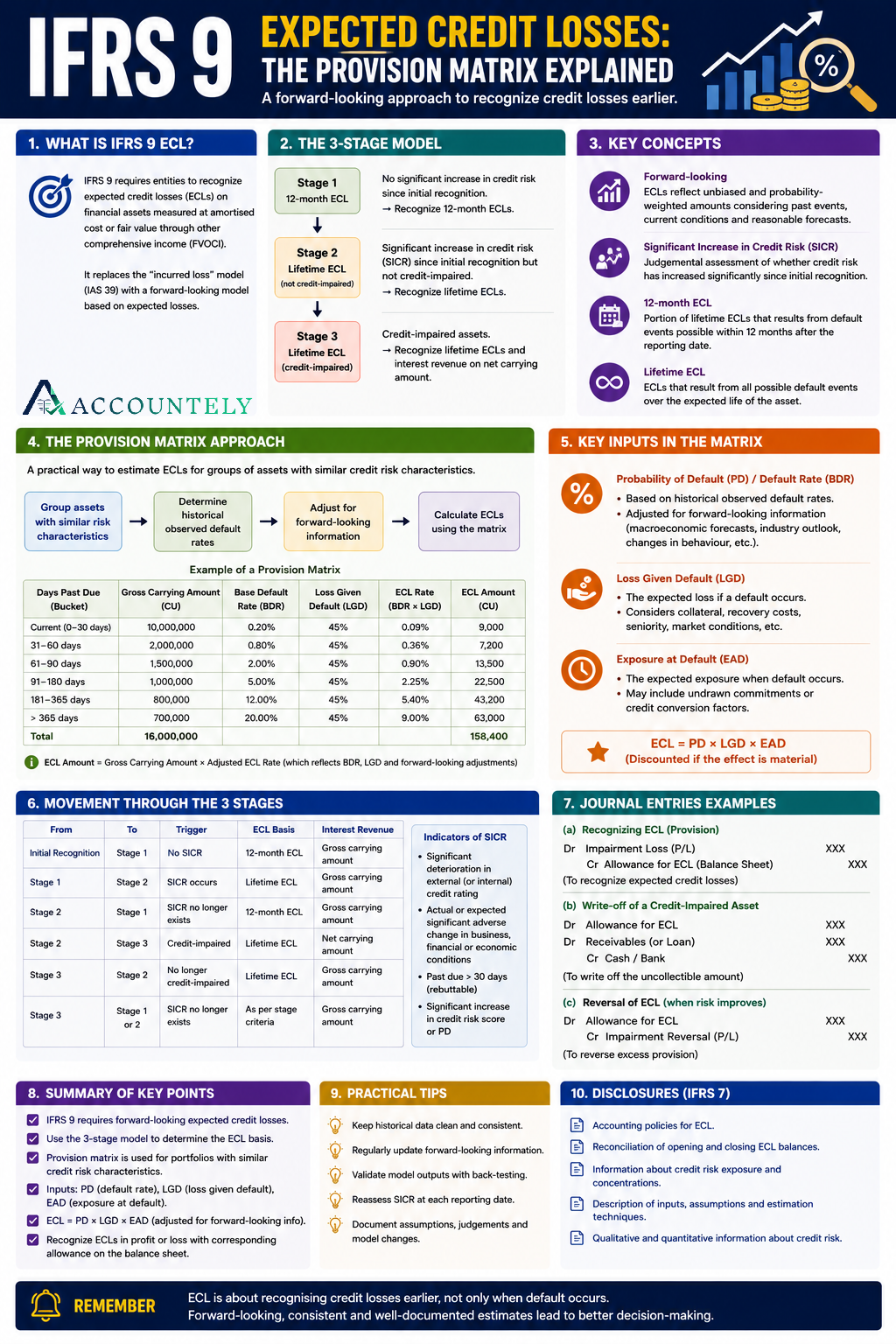
IFRS 9 replaced the old incurred loss model with an expected credit loss model, and the change is more radical than it sounds. Under the old rules you waited for evidence that a receivable had gone bad. Under IFRS 9 you recognise a loss allowance on day one, on a perfectly healthy receivable, because some proportion of any portfolio will not pay. For students, the practical territory is classification of financial assets and the ECL allowance on trade receivables.
Classification: Three Categories
IFRS 9 classifies financial assets using two tests — the entity's business model for managing the assets, and the contractual cash flow characteristics of the asset (the "SPPI" test: are the cash flows solely payments of principal and interest?).
Amortised cost — the business model is to hold the asset to collect contractual cash flows, and the cash flows are solely principal and interest. Trade receivables and most loans sit here.
Fair value through other comprehensive income (FVOCI) — the business model is achieved by both collecting contractual cash flows and selling, and the SPPI test is met.
Fair value through profit or loss (FVTPL) — everything else, including assets held for trading and any asset failing SPPI. This is the residual category.
Equity investments always fail the SPPI test, so they default to FVTPL — with an irrevocable election available at initial recognition to present fair value changes in OCI instead, for equities not held for trading. Under that election, gains and losses are never recycled to profit or loss, even on disposal.
The Three-Stage ECL Model
For assets at amortised cost and FVOCI, IFRS 9 uses a general model with three stages:
Stage 1 — credit risk has not increased significantly since initial recognition. Recognise 12-month expected credit losses: losses from default events possible within the next twelve months. Interest revenue is calculated on the gross carrying amount.
Stage 2 — credit risk has increased significantly, but the asset is not credit-impaired. Recognise lifetime expected credit losses. Interest still on the gross carrying amount.
Stage 3 — the asset is credit-impaired. Still lifetime ECL, but interest revenue is now calculated on the net carrying amount (gross less the allowance).
The move from stage 1 to stage 2 is the significant one: the allowance jumps from twelve months of losses to lifetime losses in a single step, which is why "significant increase in credit risk" is such a contested judgement in practice.
The Simplified Approach for Trade Receivables
Tracking credit risk changes on thousands of small trade receivables would be absurd, so IFRS 9 provides a simplified approach: recognise lifetime expected credit losses from initial recognition, with no stage assessment at all.
This approach is required for trade receivables and contract assets that contain no significant financing component. It is optional (an accounting policy choice, applied consistently) for trade receivables and contract assets that do contain a significant financing component, and for lease receivables.
Worked Example: A Provision Matrix
The simplified approach is usually applied through a provision matrix based on ageing and historical loss rates. A company's receivables at 31 December 2026:
- Not past due: $800,000 — expected loss rate 0.5%
- 1–30 days past due: $250,000 — 2%
- 31–60 days past due: $120,000 — 8%
- 61–90 days past due: $60,000 — 20%
- More than 90 days: $40,000 — 50%
Allowance required:
$800,000 × 0.5% = $4,000
$250,000 × 2% = $5,000
$120,000 × 8% = $9,600
$60,000 × 20% = $12,000
$40,000 × 50% = $20,000
Total allowance = $50,600
If the existing allowance is $38,000, the entry recognises only the movement:
Dr Impairment Loss on Receivables — $12,600
Cr Loss Allowance — $12,600
Two points earn marks here. Note that even the current, not-past-due balance carries an allowance — that is precisely what makes this an expected loss model rather than an incurred loss one. And note that the charge is the movement, not the closing balance.
Measuring ECL Properly
IFRS 9 requires expected credit losses to be measured in a way that reflects:
- An unbiased and probability-weighted amount determined by evaluating a range of possible outcomes — not a single best-guess scenario
- The time value of money — ECLs are discounted to the reporting date at the original effective interest rate
- Reasonable and supportable information available without undue cost or effort about past events, current conditions and forecasts of future economic conditions
That last point is what makes the model forward-looking. Historical loss rates are the starting point, not the answer — they must be adjusted for expected future conditions, which is why loss allowances rose sharply across the market during economic downturns.
Where Marks Are Usually Lost
- Charging the closing allowance to profit or loss. Recognise the movement between opening and closing allowance.
- Applying no allowance to current receivables. Expected losses apply from day one, including on balances not yet due.
- Using the three-stage model for trade receivables. The simplified lifetime approach is mandatory where there's no significant financing component.
- Recycling FVOCI equity gains on disposal. Under the equity election, gains never go through profit or loss — unlike FVOCI debt instruments, which do recycle.
- Calculating stage 3 interest on the gross amount. Once credit-impaired, interest is on the net carrying amount.
- Basing ECL on a single most-likely outcome. The measurement must be probability-weighted across scenarios.
IFRS 9's classification half rewards learning the two tests cold, and its ECL half rewards remembering that you post movements, not balances. Accountely's bad debts and allowance challenges work through provision matrices with the movement calculation marked separately, and the investments challenges cover the classification categories. For the wider IFRS/US GAAP picture — US GAAP uses a different CECL model — see IFRS vs US GAAP key differences.