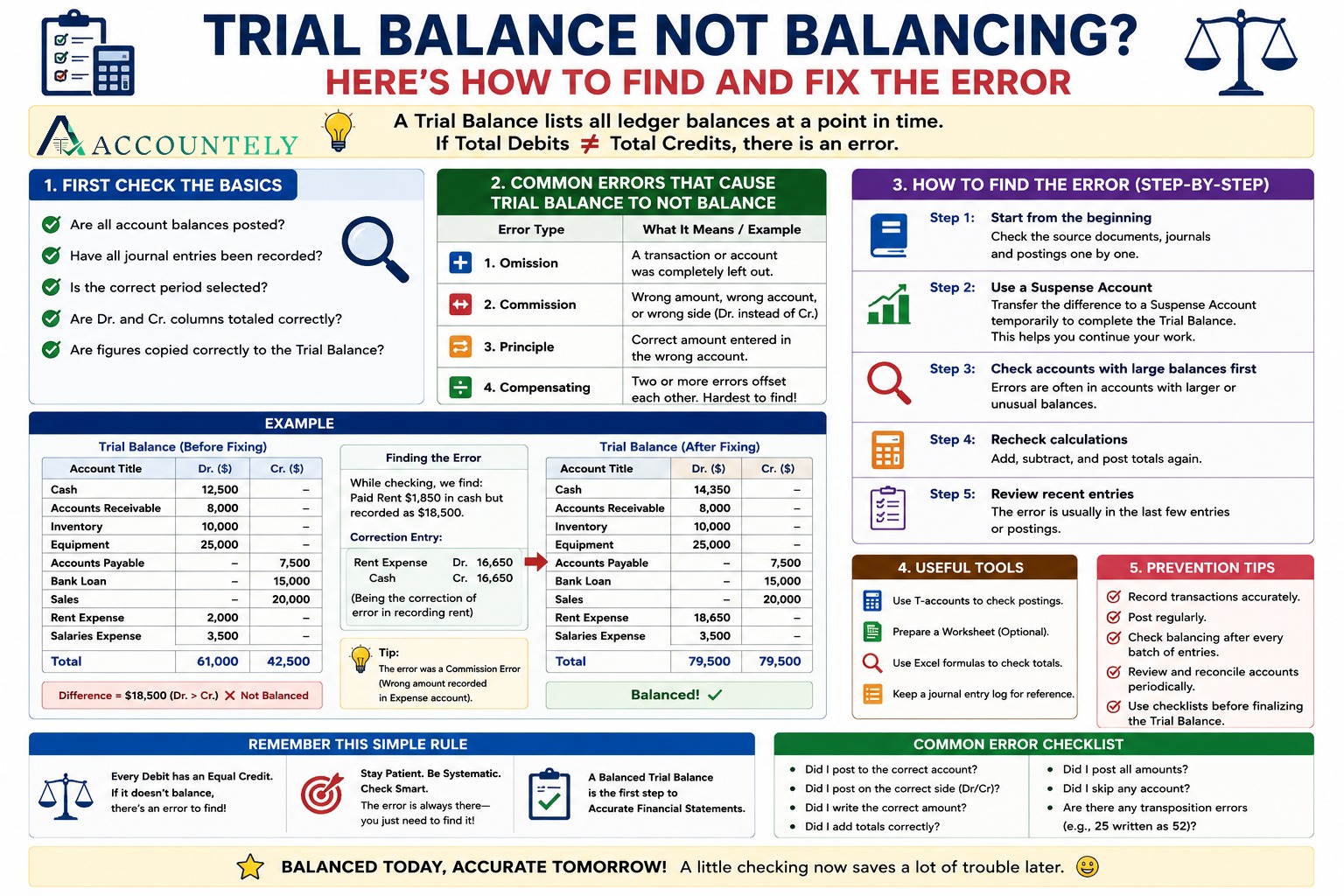
Few things are more frustrating in an intro accounting course than a trial balance that refuses to balance. The good news: the difference between your debit and credit totals is actually a clue, not just bad news — and most causes fall into a short, predictable list.
What a Trial Balance Actually Checks
A trial balance lists every account and its balance, sorted into debit and credit columns. If the books were kept correctly — every journal entry posted with equal debits and credits — the two column totals must match. A trial balance that doesn't balance is proof that somewhere, that rule was broken. It doesn't tell you where, but the size of the difference is often a strong hint.
Step 1: Check the Difference Itself
- Divisible by 9? This usually points to a transposition error — digits swapped, like writing 540 instead of 450. The difference between any two numbers with swapped digits is always divisible by 9.
- Exactly double an account balance? A likely sign that an amount was posted to the correct side of the wrong account, or to the wrong side of the correct account, instead of being split into a debit and a credit.
- Matches a specific transaction amount exactly? That entry was probably omitted from one side entirely, or posted twice on the same side.
Step 2: Re-add the Columns
Before hunting through every ledger account, just re-add both the debit and credit column totals. Simple addition errors happen more often than people expect, especially with long trial balances.
Step 3: Check Each Balance Was Copied Correctly
Trace each account balance from the ledger to the trial balance. A balance transposed, mis-copied, or listed under the wrong column (debit balance listed as credit, or vice versa) is one of the most common causes.
Step 4: Check for Half-Posted Entries
Go back through the journal and confirm every entry actually has both its debit and credit side posted to the ledger. A one-sided posting — debiting an account but forgetting the corresponding credit — is the single most common cause of an unbalanced trial balance.
Step 5: Watch for Errors the Trial Balance Can't Catch
Some mistakes never show up as an imbalance, because they still keep debits equal to credits:
- Error of omission — an entire transaction never recorded at all.
- Error of commission — posted to the wrong account, but the correct type (e.g., debiting "Office Supplies" instead of "Equipment").
- Error of principle — posted to the wrong category of account (e.g., treating a capital purchase as an expense).
- Compensating errors — two separate mistakes that happen to cancel each other out.
These require actually reviewing individual transactions, not just re-checking totals — the trial balance will look perfectly fine even though the books are wrong.
A Practical Checklist
- Re-add both column totals.
- Divide the difference by 2 — check if any single balance matches (a debit posted as a credit, or vice versa).
- Divide the difference by 9 — check for a transposition.
- Trace every ledger balance to the trial balance listing.
- Confirm every journal entry has both a debit and credit line posted.
Nothing builds this instinct faster than deliberately working through trial balance problems and getting immediate, specific feedback on what's wrong. Accountely's trial balance challenges score each figure individually, so you can see exactly which account is off instead of just an unbalanced total.