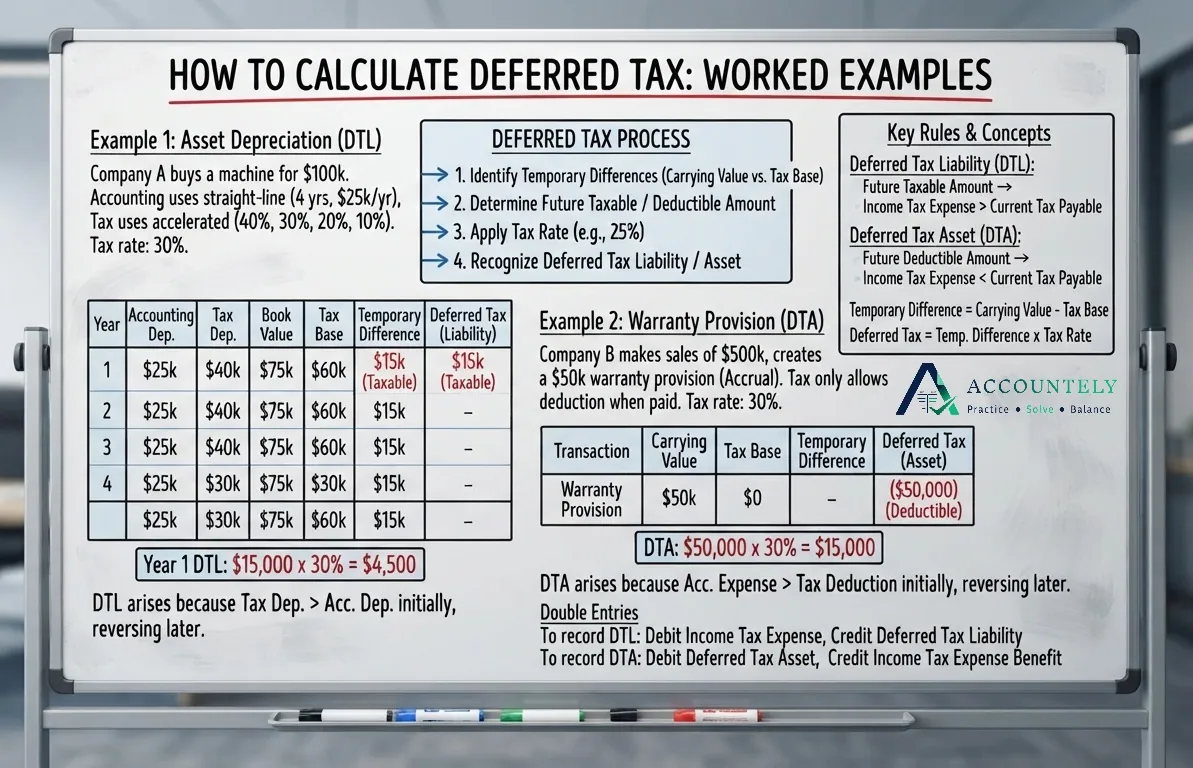
Deferred tax questions look intimidating, but nearly all of them use one calculation: compare each asset's or liability's carrying amount with its tax base, multiply the difference by the tax rate, and post the movement in the balance. This page works through that calculation five times, from a single asset to a full year-end schedule with a rate change and a tax loss. For the concepts behind it (what a tax base is, and why IAS 12 takes a balance sheet approach), read IAS 12 income taxes and deferred tax first.
The method in seven steps
- List each asset and liability whose accounting and tax treatment differ.
- Find its carrying amount: the figure on the balance sheet.
- Find its tax base: the amount the tax authorities attribute to it.
- Take the difference. That is the temporary difference.
- Decide its direction. An asset carried above its tax base, or a liability carried below it, is a taxable difference and gives a deferred tax liability. The opposite is a deductible difference and gives a deferred tax asset.
- Multiply by the tax rate expected to apply when the difference reverses, using rates enacted (US GAAP) or substantively enacted (IFRS) by the reporting date.
- Compare the closing balance with the opening balance and post only the movement.
Step 7 is where most marks go. Deferred tax is a balance sheet figure, and each year's entry is just the change needed to reach the new balance.
Example 1: One asset over its whole life
A company buys a machine for $120,000 at the start of Year 1. It depreciates the machine straight-line over 4 years, at $30,000 a year. The tax rules allow the cost to be deducted over 2 years, at $60,000 a year. The tax rate is 30%. Calculate the deferred tax balance and the movement for each year.
| Year | Carrying amount | Tax base | Taxable difference | Deferred tax liability (30%) | Movement |
|---|---|---|---|---|---|
| 1 | 90,000 | 60,000 | 30,000 | 9,000 | +9,000 |
| 2 | 60,000 | 0 | 60,000 | 18,000 | +9,000 |
| 3 | 30,000 | 0 | 30,000 | 9,000 | −9,000 |
| 4 | 0 | 0 | 0 | 0 | −9,000 |
In Years 1 and 2 the company deducts more for tax than it charges in its accounts, so its tax bill is lower now and higher later. The liability builds up to $18,000 and then unwinds to nil by the end of the asset's life. Over the four years the movements sum to zero: the timing of the tax differs, but the total does not.
The Year 1 and 2 entry is Dr Deferred tax expense 9,000, Cr Deferred tax liability 9,000. In Years 3 and 4 it reverses: Dr Deferred tax liability 9,000, Cr Deferred tax expense 9,000.
Example 2: Total tax expense for the year
Continue with Example 1. In Year 1 the company's accounting profit before tax is $200,000, and the machine is the only difference between accounting and tax. Calculate current tax, deferred tax and the total tax expense, and give the journal entry.
| $ | |
|---|---|
| Accounting profit before tax | 200,000 |
| Add back: accounting depreciation | 30,000 |
| Less: tax depreciation | (60,000) |
| Taxable profit | 170,000 |
| Current tax at 30% | 51,000 |
| Deferred tax (movement from Example 1) | 9,000 |
| Total income tax expense | 60,000 |
| Account | Debit | Credit |
|---|---|---|
| Income tax expense | 60,000 | |
| Current tax payable | 51,000 | |
| Deferred tax liability | 9,000 |
Total tax expense of $60,000 is exactly 30% of the $200,000 accounting profit. That is the point of deferred tax: it matches the tax charge to the profit reported, even when the tax actually paid this year is different. Checking that total expense ÷ profit before tax = the tax rate is a quick test of your answer. When it does not hold, the cause is usually a permanent difference (Example 3), a rate change (Example 4) or an error.
Example 3: Several differences at the year end
At December 31, 2026 a company has the following items. The tax rate is 30%, and the opening net deferred tax liability was $7,200. Calculate the closing deferred tax balance and the charge for the year.
- Property, plant and equipment: carrying amount $450,000, tax base $380,000.
- Warranty provision: $40,000. Tax relief is given only when warranty claims are paid.
- Interest receivable: $10,000. It is taxed when received.
- Receivables of $100,000 less an allowance of $5,000. Tax relief is given only when a debt is written off.
- A regulatory fine payable of $8,000. It is never tax-deductible.
Answer
| Item | Carrying amount | Tax base | Taxable | Deductible |
|---|---|---|---|---|
| PPE | 450,000 | 380,000 | 70,000 | |
| Warranty provision (liability) | 40,000 | 0 | 40,000 | |
| Interest receivable | 10,000 | 0 | 10,000 | |
| Receivables, net | 95,000 | 100,000 | 5,000 | |
| Fine payable | 8,000 | 8,000 | ||
| Totals | 80,000 | 45,000 |
- Deferred tax liability: 80,000 × 30% = $24,000
- Deferred tax asset: 45,000 × 30% = $13,500
- Net deferred tax liability: 24,000 − 13,500 = $10,500
- Charge for the year: 10,500 − 7,200 = $3,300, so Dr Deferred tax expense 3,300, Cr Deferred tax liability 3,300
Two points decide this question. The fine creates no deferred tax: it will never be deducted, so its tax base equals its carrying amount and the difference is permanent. It only explains why the company's effective tax rate is above 30%. And netting the asset against the liability is allowed only when they relate to the same tax authority and the entity has a legal right to offset (IAS 12.74). If they do not, both figures are shown gross.
Example 4: The tax rate changes
Continue with Example 3. In January 2027 a lower rate of 25% is enacted for all future years. The temporary differences at December 31, 2027 are the same as in Example 3. What is the deferred tax entry for 2027?
Answer
- Opening net liability, at 30%: $10,500
- Closing net liability: (80,000 − 45,000) × 25% = $8,750
- Movement: 10,500 − 8,750 = $1,750 decrease: Dr Deferred tax liability 1,750, Cr Deferred tax expense 1,750
The whole balance is remeasured at the new rate, including the parts built up in earlier years. The effect goes to profit or loss here because the original differences arose there. Deferred tax on an item recognized in other comprehensive income, such as a revaluation surplus, is remeasured through other comprehensive income.
Timing matters. A rate enacted after the reporting date but before the accounts are approved is a non-adjusting event and is disclosed, not booked. This rate was enacted in January 2027, so it does not change the December 31, 2026 balance and is first used at December 31, 2027. Under IFRS a rate that is substantively enacted by the reporting date is used even if not yet formally law. US GAAP waits for enactment. See IAS 10 events after the reporting period.
Example 5: A tax loss carried forward
A company makes a tax loss of $50,000 that can be carried forward against future taxable profits. The tax rate is 25%. Should it recognize a deferred tax asset?
Answer
The potential asset is 50,000 × 25% = $12,500, recorded as Dr Deferred tax asset 12,500, Cr Deferred tax income 12,500. Whether it is recognized depends on future profits:
- IFRS (IAS 12): recognize it only to the extent that future taxable profit is probable. A history of recent losses counts as strong evidence that it is not, so the company needs convincing evidence, such as taxable differences that will reverse or firm tax-planning opportunities.
- US GAAP (ASC 740): recognize the full asset, then reduce it with a valuation allowance if it is more likely than not (above 50%) that some of it will not be realized.
The two routes usually reach a similar net figure, but the US presentation keeps the gross asset and the allowance visible separately.
Common deferred tax mistakes
- Posting the balance instead of the movement. If last year's liability was $18,000 and this year's is $9,000, the entry is a $9,000 credit to expense, not a new $9,000 liability.
- Getting the direction wrong for liabilities. A provision with a tax base of nil creates a deferred tax asset, because the tax deduction is still to come.
- Applying deferred tax to permanent differences. Fines, most entertainment costs and tax-exempt income never reverse, so they have no deferred tax.
- Using the current year's rate when a different future rate has already been enacted.
- Forgetting the recognition test on deferred tax assets, especially those arising from losses.
Practice it
Deferred tax gets easier with repetition, and checking a full schedule by hand is slow. Accountely's income tax challenges give you the carrying amounts and tax bases and grade your schedule and journal entries line by line. The IAS 12 guide covers the recognition rules in more depth. It's free to start.
Frequently Asked Questions
What is the formula for deferred tax?
Deferred tax equals the temporary difference multiplied by the tax rate. The temporary difference is the carrying amount less the tax base for an asset, and the tax base less the carrying amount for a liability. The entry for the year is the closing balance less the opening balance.
How do I know if it is a deferred tax asset or a liability?
Ask whether the difference will make future tax higher or lower. An asset carried above its tax base, such as equipment depreciated faster for tax, means more tax later, so it is a liability. A liability carried above its tax base, such as a provision deductible only when paid, means less tax later, so it is an asset.
Which tax rate should I use?
Use the rate expected to apply when the difference reverses, based on laws in place at the reporting date. That means rates substantively enacted under IFRS, or enacted under US GAAP. If the rate changes, remeasure the whole balance.
Is deferred tax paid in cash?
No, not directly. Deferred tax is an accounting balance that spreads the tax effect of timing differences. Cash tax is the current tax payable to the authorities each year. Deferred tax changes reported profit, not this year's cash.