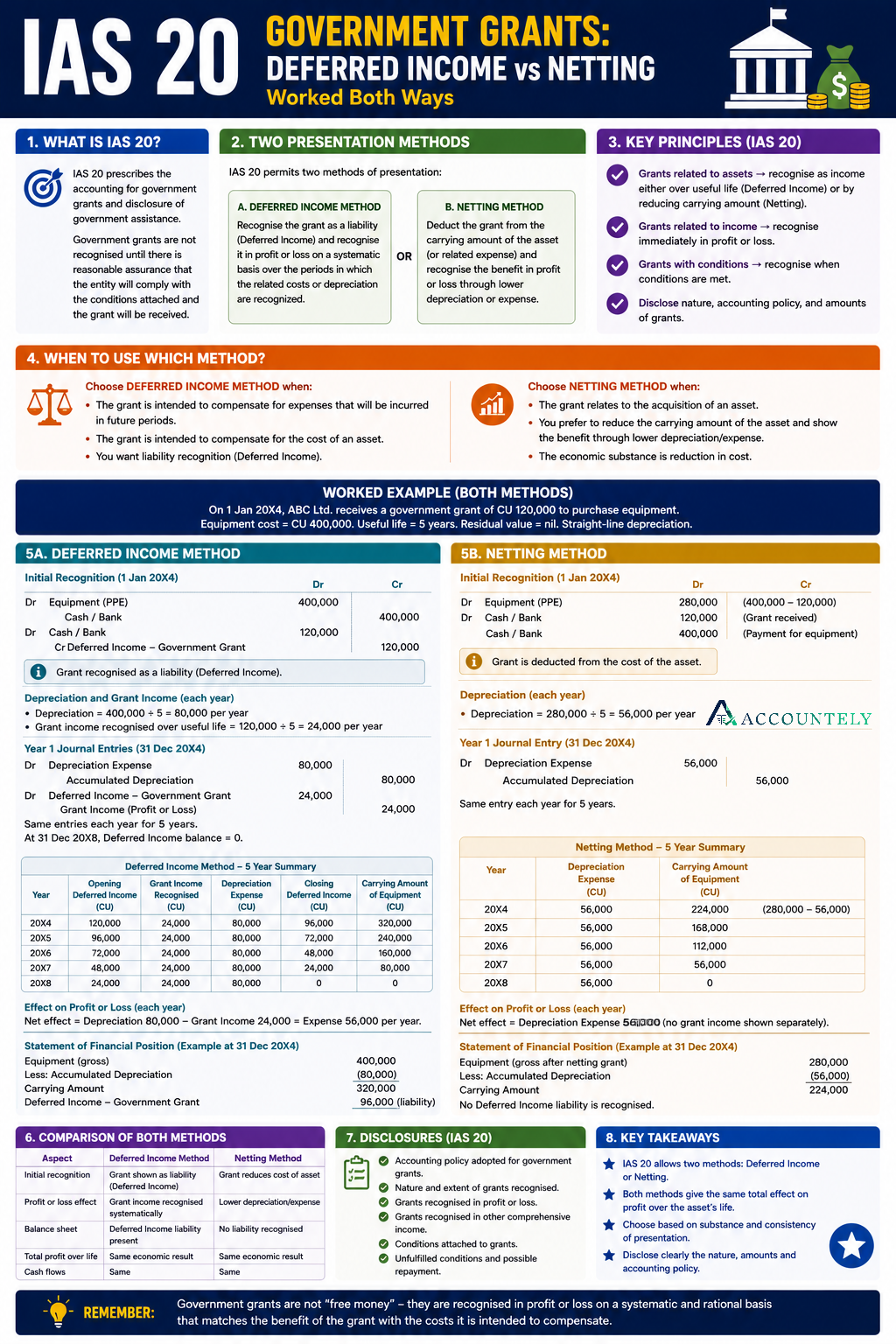
IAS 20 deals with money a government gives a business, and its central principle is one line long: grants are recognised in profit or loss over the periods in which the entity recognises as expenses the related costs the grant is intended to compensate. Everything else in the standard is a consequence of that matching idea. The difficulty is entirely in the presentation choices, where IAS 20 offers two acceptable answers for almost every question.
The Recognition Rule
A government grant is not recognised until there is reasonable assurance that:
1. The entity will comply with the conditions attaching to the grant, and
2. The grant will be received
Both conditions matter, and the first is the one that bites. Actually receiving the cash is not conclusive evidence that the conditions have been or will be met — an entity can hold grant money it may yet have to repay. Receipt alone does not trigger recognition in profit or loss.
Once recognised, a grant is taken to profit or loss on a systematic basis over the periods in which the related costs are recognised. Grants are never credited directly to equity — IAS 20 takes the income approach, not the capital approach.
Two Types of Grant, Two Sets of Presentation Options
Grants related to assets — the primary condition is that the entity should purchase, construct or otherwise acquire long-term assets.
Two permitted presentations:
- Deferred income method — set the grant up as deferred income and release it to profit or loss on a systematic basis over the asset's useful life
- Netting method — deduct the grant in arriving at the carrying amount of the asset. Depreciation is then charged on the reduced figure, which achieves the same profit effect through a smaller depreciation charge
Grants related to income — any grant other than one related to assets.
Two permitted presentations:
- Present as a separate credit, or under a general heading such as "other income"
- Deduct the grant in reporting the related expense
Worked Example: Both Methods, Same Profit
A company receives a $200,000 government grant on 1 January 2026 towards machinery costing $800,000, with a 10-year useful life and no residual value.
Method 1 — Deferred income
On receipt:
Dr Cash — $200,000
Cr Deferred Income — Government Grant — $200,000
Each year:
Dr Depreciation Expense — $80,000 ($800,000 ÷ 10)
Cr Accumulated Depreciation — $80,000
Dr Deferred Income — $20,000 ($200,000 ÷ 10)
Cr Other Income — Grant — $20,000
Net annual charge to profit: $60,000. Balance sheet shows the asset at $800,000 less depreciation, and remaining deferred income as a liability, split current and non-current.
Method 2 — Netting
Asset carrying amount: $800,000 − $200,000 = $600,000
Each year:
Dr Depreciation Expense — $60,000 ($600,000 ÷ 10)
Cr Accumulated Depreciation — $60,000
Net annual charge to profit: $60,000.
Profit is identical under both. What differs is the balance sheet — $200,000 more in both assets and liabilities under the deferred income method — and the gross depreciation figure. Since the profit effect is the same, exam questions usually ask for both, and marks come from showing the presentation difference clearly.
Non-Monetary Grants and Below-Market Loans
Where a grant takes the form of a non-monetary asset — land transferred for a nominal sum, say — the grant and the asset are normally recorded at the asset's fair value. An alternative permitted treatment records both at a nominal amount.
A government loan at a below-market rate of interest is treated as a grant. The loan is recognised and measured under IFRS 9 at fair value, and the benefit — the difference between the proceeds received and the initial fair value of the loan — is the government grant, accounted for under IAS 20.
Repayment of a Grant
A grant that becomes repayable is accounted for as a change in accounting estimate under IAS 8 — prospectively, with no restatement of prior periods.
For a grant related to income, the repayment is applied first against any unamortised deferred credit, and any excess is recognised immediately as an expense.
For a grant related to assets, the repayment increases the asset's carrying amount, or reduces the deferred income balance, by the amount repayable. The cumulative additional depreciation that would have been recognised to date in the absence of the grant is recognised immediately as an expense — this catch-up charge is the part most often missed.
What IAS 20 Does Not Cover
The standard explicitly excludes government assistance provided through tax benefits — tax holidays, investment tax credits, accelerated depreciation, reduced tax rates. Those fall under IAS 12. It also excludes government participation in the ownership of the entity, and grants covered by IAS 41 Agriculture.
Where Marks Are Usually Lost
- Recognising the whole grant as income on receipt. It is matched to the related costs over time — for an asset grant, over the asset's useful life.
- Crediting the grant directly to equity. Prohibited. IAS 20 uses the income approach.
- Depreciating the gross cost under the netting method. If the grant was netted off, depreciate the reduced carrying amount.
- Treating receipt of cash as reasonable assurance of compliance. The conditions test is separate and independent.
- Forgetting the catch-up depreciation on repayment of an asset-related grant.
- Restating prior periods on repayment. It's a change in estimate — prospective only.
- Applying IAS 20 to a tax holiday. Tax-based assistance is scoped out.
IAS 20 questions usually ask you to prepare both presentations and comment on the difference, so practise both rather than picking a favourite. Accountely's government grants challenges cover the deferred income and netting methods side by side, marking the presentation choice separately from the release calculation. Since asset grants feed directly into a depreciation schedule, IAS 16 property, plant and equipment is the useful companion, and repayments hinge on IAS 8's estimate-change rules.