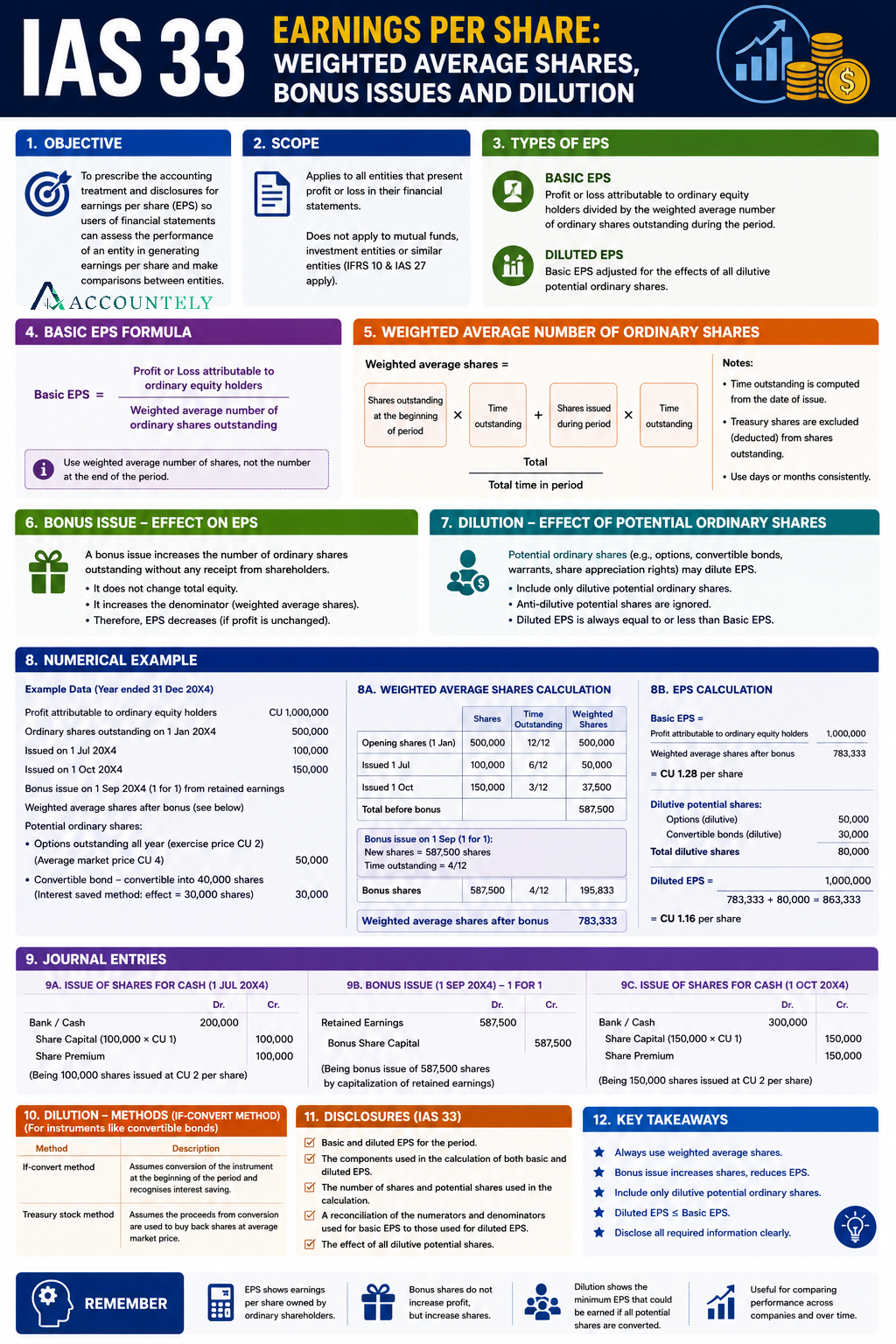
EPS is the single most quoted number in financial reporting and the one most easily manipulated by getting the denominator wrong. IAS 33 exists to make the figure comparable — between companies, and between periods for the same company. The standard is almost entirely about the denominator: the numerator is usually handed to you.
Basic EPS
The formula:
Basic EPS = Profit attributable to ordinary equity holders of the parent ÷ Weighted average number of ordinary shares outstanding
The numerator is profit or loss attributable to the parent's ordinary shareholders. That means starting from profit after tax, then deducting preference dividends — because preference shareholders are not ordinary equity holders.
An important distinction on preference dividends: for cumulative preference shares, deduct the dividend for the period whether or not it was declared. For non-cumulative preference shares, deduct only dividends actually declared. A missed cumulative dividend still accrues to those holders, so it still reduces what belongs to ordinary shareholders.
The Weighted Average: Three Share Events, Three Treatments
Shares issued mid-year only contributed capital for part of the year, so they are time-weighted. But two kinds of issue are not weighted, and that distinction is the standard's main trap.
Issue at full market price (cash issue) — time-weighted from the date of issue. New resources entered the business partway through, so they only earned for part of the year.
Bonus issue (scrip issue, stock dividend) — no time weighting. Treated as if the shares had always been in issue, and comparatives are restated. No resources entered the business — the same pie is simply cut into more slices, so it would be misleading to show EPS falling only in the second half.
Rights issue — a hybrid. It is partly a full-price issue and partly a bonus, because shares are offered below market price. Apply a bonus fraction to the period before the issue, then time-weight the new shares from the issue date. Comparatives are restated by the same bonus fraction.
Worked Example: Basic EPS with a Mid-Year Issue
A company has 1,000,000 ordinary shares at 1 January 2026. On 1 July 2026 it issues 400,000 shares at full market price. Profit after tax is $2,340,000. Cumulative preference dividends of $140,000 relate to the year (none were declared).
Numerator: $2,340,000 − $140,000 = $2,200,000
Denominator: (1,000,000 × 12/12) + (400,000 × 6/12) = 1,000,000 + 200,000 = 1,200,000
Basic EPS = $2,200,000 ÷ 1,200,000 = $1.83
Note the preference dividend is deducted despite not being declared, because the shares are cumulative.
Worked Example: The Rights Issue Bonus Fraction
A company has 2,000,000 shares. On 1 October 2026 it makes a 1-for-4 rights issue at $3.00 per share, when the market price immediately before was $4.50.
First compute the theoretical ex-rights price (TERP):
4 existing shares at $4.50 = $18.00
1 new share at $3.00 = $3.00
5 shares worth $21.00 → TERP = $21.00 ÷ 5 = $4.20
Bonus fraction = market price before ÷ TERP = $4.50 ÷ $4.20 = 15/14
Weighted average shares:
1 Jan – 30 Sep: 2,000,000 × 9/12 × 15/14 = 1,607,143
1 Oct – 31 Dec: 2,500,000 × 3/12 = 625,000
Weighted average = 2,232,143
The prior year's EPS is also restated by multiplying its denominator by 15/14 — otherwise the comparative would be measured on a different basis.
Diluted EPS
Diluted EPS shows what EPS would be if all dilutive potential ordinary shares were converted. Potential ordinary shares include convertible bonds, convertible preference shares, share options and warrants.
Convertible instruments — assume conversion at the start of the period (or issue date if later). Add the shares to the denominator; add back to the numerator the post-tax interest or dividend saved, since it would no longer be payable.
Options and warrants — use the treasury stock method. Assume the options are exercised and the proceeds used to buy back shares at average market price. Only the net shares issued for no consideration enter the denominator.
The critical filter: a potential ordinary share is included only if it is dilutive — only if it reduces EPS. Anti-dilutive instruments are ignored entirely. Options are dilutive only when the exercise price is below the average market price.
Worked Example: Convertible Bonds
Using the first example (profit to ordinary holders $2,200,000, weighted average 1,200,000 shares, basic EPS $1.83), the company also has $2,000,000 of 6% convertible bonds, convertible into 300,000 ordinary shares. The tax rate is 25%.
Interest saved: $2,000,000 × 6% = $120,000
Post-tax: $120,000 × (1 − 0.25) = $90,000
Adjusted numerator: $2,200,000 + $90,000 = $2,290,000
Adjusted denominator: 1,200,000 + 300,000 = 1,500,000
Diluted EPS = $2,290,000 ÷ 1,500,000 = $1.53
$1.53 is below the basic $1.83, so the bonds are dilutive and are included. Had the result exceeded $1.83, they would be anti-dilutive and excluded.
Where Marks Are Usually Lost
- Time-weighting a bonus issue. Bonus issues are treated as though always in issue, and comparatives restated.
- Forgetting to restate comparatives after a bonus or rights issue.
- Using pre-tax interest saved on convertible bonds. The add-back is net of tax.
- Including anti-dilutive instruments. Test each one; anything that raises EPS is excluded.
- Deducting non-cumulative preference dividends that weren't declared. Only cumulative dividends accrue regardless of declaration.
- Adding all option shares to the denominator. Only the net bonus element under the treasury stock method.
EPS questions are denominator questions — almost every lost mark is a share event weighted the wrong way. Accountely's earnings per share challenges and dilution challenges mark the weighted average separately from the final figure, so a bonus fraction slip doesn't hide otherwise sound work. For where EPS sits on the face of the statement, see IAS 1 presentation of financial statements.