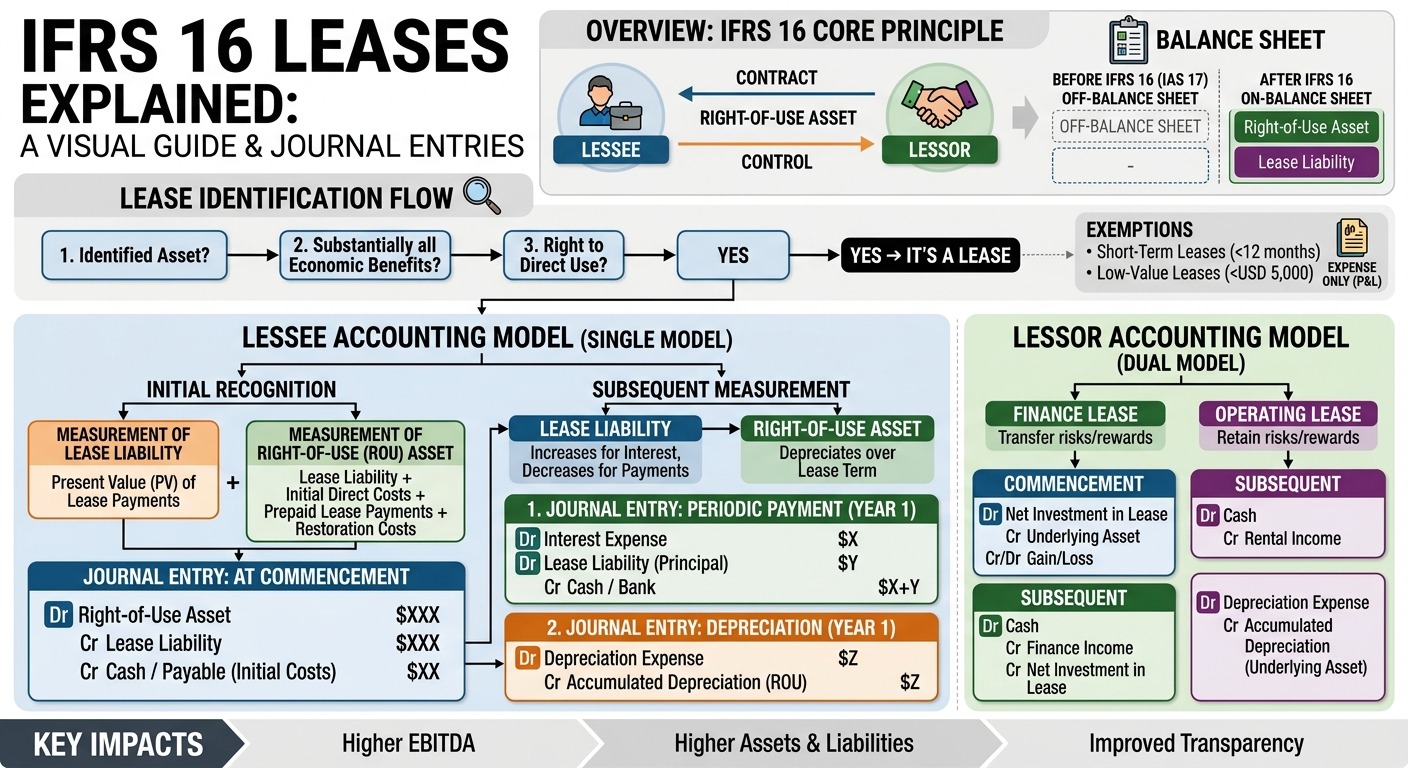
Before 2019, a company could sign a fifteen-year lease on its head office, commit to millions in payments, and show none of it on the balance sheet. The rent simply appeared as an expense each year. Analysts knew this and adjusted for it manually; everyone else was reading a balance sheet that understated what the business actually owed.
IFRS 16 ended that. Effective for periods beginning on or after 1 January 2019, it replaced IAS 17 and pulled almost every lease onto the lessee's balance sheet. If you are studying financial reporting, this is one of the standards you will be tested on repeatedly, because it changes the numbers rather than just the wording.
The single lessee model
Under IAS 17, lessees split leases into two types. A finance lease — one that transferred substantially all the risks and rewards of ownership — went on the balance sheet. An operating lease did not; it was a straight-line rent expense and a note in the accounts. Predictably, a great deal of effort went into structuring leases to land on the operating side of that line.
IFRS 16 removes the choice for lessees. There is now one model, and it starts from a different question: not "who bears the risks and rewards?" but "does the customer control the use of an identified asset for a period of time in exchange for consideration?" If yes, there is a lease, and the lessee recognises two things:
- A right-of-use asset — the right to use that asset for the lease term
- A lease liability — the obligation to make the lease payments
The logic is worth pausing on, because it explains everything that follows. You have not bought the building. What you have bought is fifteen years of access to it, and that right is an asset you control. The unpaid rent is a liability you cannot avoid. Both belong on the balance sheet.
Measuring the lease liability
At commencement, the lease liability is the present value of the lease payments not yet paid. Discounting matters here: a promise to pay $100,000 a year for ten years is not a $1,000,000 liability, because most of that money is paid years from now.
Which rate do you discount at? IFRS 16 sets an order:
- The interest rate implicit in the lease, if it is readily determinable. This is the rate that makes the present value of the lease payments plus the unguaranteed residual value equal the fair value of the asset plus the lessor's initial direct costs.
- The lessee's incremental borrowing rate, if it is not. This is the rate the lessee would pay to borrow, over a similar term and with similar security, the funds needed to obtain a similar asset.
In practice the implicit rate is rarely determinable, because it depends on the lessor's assumptions about residual value — information the lessee usually does not have. Most lessees end up using the incremental borrowing rate. Exam questions almost always hand you the rate; the marks are in knowing which one you were given and why.
Measuring the right-of-use asset
The asset is not simply equal to the liability, though it usually starts close. It is:
| Component | Effect |
|---|---|
| Initial lease liability | Starting point |
| Payments made at or before commencement | Add |
| Initial direct costs incurred by the lessee | Add |
| Estimated dismantling / restoration costs | Add |
| Lease incentives received | Deduct |
A rent-free period or a contribution to fit-out costs is an incentive, and it reduces the asset rather than being spread as a separate credit.
A worked example
A company leases equipment for four years from 1 January. Payments are $50,000 annually in arrears. The incremental borrowing rate is 8%. The present value of four payments of $50,000 at 8% is approximately $165,600.
At commencement:
Debit Right-of-Use Asset 165,600; credit Lease Liability 165,600.
End of year 1. Two separate things now happen, and keeping them separate is the whole skill.
Interest accrues on the liability: 165,600 × 8% = $13,248. Debit Interest Expense 13,248; credit Lease Liability 13,248.
The payment is made: debit Lease Liability 50,000; credit Cash 50,000. The liability falls to 165,600 + 13,248 − 50,000 = $128,848.
Separately, the asset is depreciated. Straight line over four years: 165,600 ÷ 4 = $41,400. Debit Depreciation Expense 41,400; credit Accumulated Depreciation 41,400.
Total expense in year 1 is 13,248 + 41,400 = $54,648 — noticeably more than the $50,000 cash paid. That gap is the point.
Why the expense is front-loaded
Depreciation is constant, but interest is charged on a liability that shrinks every year. Year 1 carries the most interest; the final year carries the least. So total expense starts above the cash rent and ends below it, even though the cash payments never change.
Under the old operating lease treatment, the same lease would have produced a flat $50,000 expense every year. IFRS 16 does not change the total cost over the lease — it changes when that cost appears. A company with a young lease portfolio reports lower profit than it would have under IAS 17; one with a mature portfolio reports higher.
The two exemptions
IFRS 16 offers two practical reliefs, and both are elective rather than mandatory:
- Short-term leases — a lease term of 12 months or less at commencement, with no purchase option. Elected by class of underlying asset.
- Low-value assets — assessed on the value of the asset when new, not on materiality to the lessee. The standard's Basis for Conclusions points at figures in the order of US$5,000. Laptops, office furniture and small IT equipment typically qualify; a car does not, however immaterial it is to a large group. Elected lease by lease.
Where an exemption is taken, the payments are recognised as an expense on a straight-line basis — effectively the old operating lease treatment.
Lessor accounting did not change
This catches people out. IFRS 16 rewrote lessee accounting and largely carried lessor accounting forward from IAS 17. Lessors still classify each lease as a finance lease or an operating lease, based on whether substantially all the risks and rewards of ownership transfer.
So the same contract can be a right-of-use asset in the customer's books and an operating lease in the supplier's. That asymmetry is deliberate, and questions like to test whether you noticed it.
What it does to the financial statements
The effects are systematic and worth being able to state:
- Balance sheet: assets and liabilities both rise. Gearing ratios worsen, sometimes sharply for retailers and airlines.
- Income statement: operating lease rent disappears and is replaced by depreciation plus interest. Because interest sits below operating profit, EBITDA improves — without anything about the business changing.
- Cash flow statement: total cash is identical, but the classification moves. The principal portion is a financing outflow; interest is financing or operating depending on the entity's accounting policy under IAS 7. Under IAS 17 the whole payment sat in operating, so operating cash flow improves too.
Two headline metrics improving with no change in economics is exactly why the standard mattered to analysts, and it is a favourite discussion question. If the distinction between profit and cash is still shaky, our guide to the income statement versus the cash flow statement covers the underlying mechanics.
Where marks are usually lost
- Recognising the liability at the undiscounted total. The liability is a present value; forgetting to discount inflates it and every figure after it.
- Setting the right-of-use asset equal to the liability automatically. They coincide only when there are no initial direct costs, prepayments, incentives or restoration obligations.
- Depreciating over the asset's useful life by default. Depreciate over the shorter of the lease term and useful life — unless ownership transfers at the end or a purchase option is reasonably certain to be exercised, in which case use the useful life.
- Charging interest on the original liability every year. Interest accrues on the carrying amount, which falls as payments are made.
- Applying the low-value exemption by materiality. It is assessed on the value of the asset when new, in absolute terms — not relative to the size of the lessee.
- Assuming lessors follow the single model too. They do not.
Practise it
Lease accounting rewards repetition more than reading, because the arithmetic is where errors hide. Working through the amortisation of a liability is close to the mechanics of notes payable, and the asset side behaves much like any other depreciable asset — if both are solid, IFRS 16 is mostly a matter of assembling parts you already know.
Accountely's accounting challenges grade every line you enter and tell you exactly which figure went wrong, which is considerably faster than checking your own workings against a model answer.